.
LIFE IS TOO SHORT TO CAPTURE EVERY PRIVATE SENSITIVITY
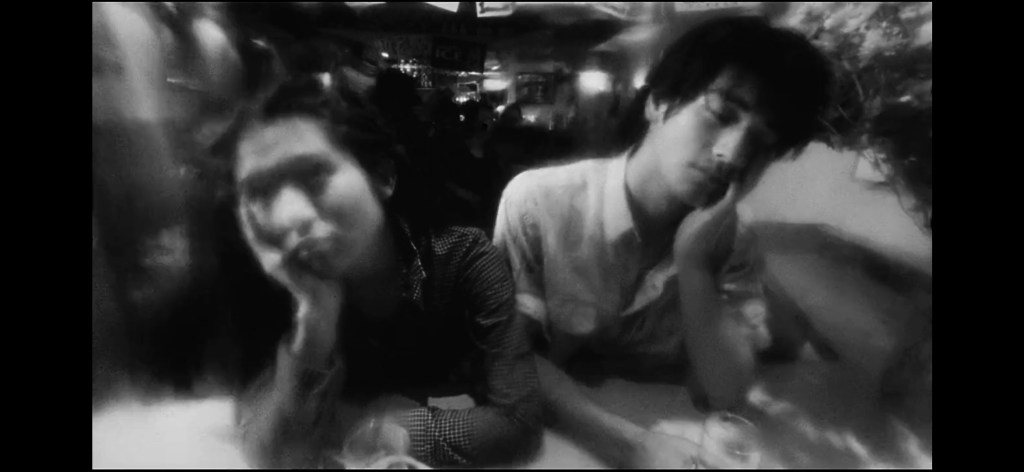
- POEM
- DIARY
- ESSAY
- FICTION
- PAINTINGS
POEM
Surreal Modern History
2025-01-20 08:56:36 Germany
Seven hundred years ago when we first met, reading Plato’s view
You said if this wind could make the door move through
Then it could turn any page, making words anew
So I fell into the black forest’s moon so true
In primitive tribes I began learning speech’s way
Through imagining our talks, practicing silence and display
Four hundred years ago I snuck into night to spy your feeding trail
Often saw you cross mountains and streams, up slopes to make water pale
While I stood ready to come say “long time no see” without fail
Whether I know you is truly our greatest question’s weight
But year after year I’ve devoured you in my mind’s deep state
.
Youth Portraits / Poem Series
2022-12-22 00:27:50 Belgium
Tiantian/Youth Portrait (I)
You say you found a job, call to tell me, you’re such a pain
I say you don’t really love her so you muddle through this strain
You say why this love feels like a position that makes you drain
I say that surely depends on your future plan to maintain
Strange Woman/Youth Portrait (II)
First time we met she told me not to fall for literature’s snare
I said you’re right, then shut my mouth, no more words to share
Second time we met she told me to see through pretense with care
I said you’re right, got up to light a smoke and cook noodles there
The Woman in Love/Adulation (III)
She says he wrote a poem just for her delight
She says he came to the big city for her sight
From hesitation to being moved took half a year’s flight
Crossing friendship to love’s worship took half a lifetime’s height
She says this version of him is her absolute pride so bright
She calls out “darling” then “baby” with all her might
Says why don’t we take a bath together tonight
The Man in Love/Farmer (IV)
He wrote a love poem thinking his talent truly grand
If not for her, he could switch the lead by his own hand
He marched forth with a sower’s passionate command
Reclaimed the youth he’d unfortunately lost from his land
Now he’s willing to be a farmer, diligent and planned
Plowing, fertilizing, working without reprimand
He never doubts this garden he tends with his own hand
Can only think for him of years flowing like foolish sand
.
Messy/ In Name of Vice Versa
The bar’s name was vice versa.
She told the bartender we would be together forever;
the bartender said he’d quit in autumn to prepare for grad school;
I said I’d come back next summer.
She licked the salt from the hollow between her thumb and index finger,
drank the first sip of tequila,
tilted her head back and squeezed 1/6 of a lemon,
letting the juice drip into her mouth.
When leaving, she drank the last sip of gin and tonic,
spitting the ice cubes into another mouth.
A year later, we broke up;
the bartender was still working at the bar;
I never went back.
.
Discipline and Punish
The poet helps people with absolute passion
Excavate meaning from ordinary life’s ration
This exchange of flesh for truth needs no confession—
It’s honest, abundant, even a noble expression
Therefore neither fiction nor delusion
He hurls his flesh toward dust and urban sprawl
With open stance rejecting one and all
Thus earning qualification to traverse every fall
And winning the right to mock and scorn them all
While they—the gradually forgotten, the exiled
Have been reduced to static symbols, entertainment filed
In vast white squares they mourn and pray, beguiled
Their unheard devotion makes them their own deity
Tireless worship, faithful piety
Day after day serving artificial candles’ weak light
Striving with all their might for sustained depletion’s rite
.
Winter/Double Warm
2022-10-29 21:08:11 Belgium
Winter’s coming soon
I have two small quilts
And one big duvet cover
Spread both flat inside the cover
When cold, sleep under the thick one on the left
When hot, roll over to the thin one on the right
When even colder, fold both quilts
And pile them on top of me
.
Say Something
2022-10-24 05:36:07 Belgium
Seeing someone write a letter made me realize
It’s been so long since I put pen to paper
I want to write a long letter to someone
About everything in my ordinary life
Like yesterday’s rain that fell so hard
I’ve finally learned to roll cigarettes
Or how lately my afternoon naps stretch so long
My head aches as if insects eat my brain
I must pour all these things into my letter
Write a hundred and one pages before sending it out
Have the recipient read each line to me on the phone
Then say I’m tired and drift deep into sleep
.
DIARY
Position, Recalibrated
2026/02/19 Swiss
I spent three days in Nice, France with Yao, Ya, and one of Ya’s Korean friends—and we happened to celebrate Chinese New Year there as well.
Yao’s arrival also seemed to bring bring my high-school self back: during these three days, I could not help but make fun of so many things. I imitated noisy kids crying on the beach, mocked those “artsy” yet painfully stupid, logic-free film reviews on social media (Yao went, “Do these people just have terrible Chinese?”), and asked our Korean friend whether Koreans really don’t need sleep…
Over those three nights in Nice, after returning to the hotel, Yao and I lay in bed and watched two films. One was Love Exposure—the relationships were unbelievably complicated, yet the emotions were expressed with a simplicity and directness that hit right in the chest. The other was Snakes and Earrings—the relationships were unbelievably simple, yet the emotions were so indirect and winding that I could not fully grasp them on a first watch (yes, it was my second time watching it).
The next day Yao told me that near the end of Love Exposure, she cried what she called “pig tears.” And after I read an analysis of Snakes and Earrings on her phone, I did the same.
After this brief reunion, I realized that we are still exactly the same as we were in high school. I almost feel like we haven’t really grown up: the topics simply shifted from studying to work, and our complaints shifted from stupid classmates to stupid students and stupid academics.
The four and a half days with her in Switzerland, plus these three days in Nice, recalibrated my principles that have been repeatedly invaded and interrupted over the years of my drifting around abroad. And the odd, ridiculous parts of my personality don’t strike her as wrong at all—because this is how I’m supposed to be. Or rather: the version of me she remembers is the version in which I feel most at ease—back when I wasn’t afraid of anything, and therefore didn’t truly care about anything; nothing could decide me, or change me.
She said it’s unbelievable to her that I’ve been able to be friends with teachers since I was still a teenager (for example, when I was at school, I would go out to eat with my middle-school Chinese teacher, my high-school English teacher, even university professors). I think that although I’m extremely picky about who I spend time with, once I need to talk, or want to talk (quite rarely though), no matter their age, role, or title, I intentionally place them on equal footing with me.
Two months ago, when I went to Leiden to see my other PhD supervisor, he said some people get frustrated in academic exchanges because they place themselves in the wrong position—in other words, they put themselves in the position of being evaluated. And I seem to have already stepped out of that position, returning instead to a more balanced state, between acting and being acted upon.
.
The Solar System Is Spinning
2026/02/13 Swiss
1.
After finishing 3 sets of 15 push-ups in the office, my hands are a little shaky. But tomorrow I’m flying to Nice for Chinese New Year. Which means I have to write a Chinese New Year version of my year-end summary today.
In early February, my high school friend Yao came to Europe for a trip. I showed her around Switzerland for four days. In the most humorous and relaxed way possible, we talked through the terrible relationship she’d been through, and the terrible relationship I’d been through—from 2020 to 2024, both of us were being worn down by them; and 2025 seems to be the year everything finally started turning for the better. Maybe that’s fate? Her birthday is only one day after mine, so we’ve ended up living through oddly similar episodes.
Trauma isn’t what’s frightening. What’s frightening is being controlled by trauma—becoming afraid of life itself, and then, out of fear, no longer daring to trust. Trauma doesn’t steal anything from me. It just teaches me what I need to guard
A friend sent me the only photo Yao and I have from high school: we were dressed up as two pandas. After we briefly said goodbye in Switzerland, she went on to Germany and Italy by herself; and then we’ll meet again in Nice for Chinese New Year.
2.
Just thinking about next semester’s schedule already makes me tired. In April, I’ll go to the Netherlands for a conference in continental philosophy (to present a paper I haven’t even started writing). In May, I’ll give a talk at a seminar in Switzerland. In June, I might go to Romania for a phenomenology course, and then to Finland for another conference (also not started). In September, I may go to Slovenia for a cross-cultural philosophy event—though for now, both the June and September plans are still waiting for confirmation. And sometime in June, I might also go to Italy on vacation with friends.
The academic calendar looks intense, but in reality, I’ve already accumulated a lot of writing material. Recently I learned a new term: “compound interest.” At this point it seems that writing mainly requires execution; it doesn’t really require panic. Honestly, once I start panicking, I don’t even know what I’m panicking about.
My project for the next six months (up to the end of August 2026) is simply to write Chapter Two of my dissertation. That’s an ideal pace. From September 2026 to April 2027, Chapter Three. From May 2027 to February 2028, Chapter Four. And in the summer of 2028, I’ll prepare to finish the PhD.
Recently I am also back to teach online philosophy classes for undergraduates and master’s students. Besides earning a little extra money, it forces me to keep touching fields I don’t fully know yet (Kant studies, philosophy of science, musicology, and so on). The only way this kind of work is “worth it,” financially, is if I learn faster than the students. Oh, I decided to deposit 300 chf, cash only, each month.
On top of that, every Saturday I teach Chinese to Swiss primary school kids. At first I thought it would just be a casual part-time job, but watching them get better and better at Chinese genuinely makes me happy.
3.
The year 2025—especially the part after summer—has been probably crucial for my whole life. Because I’m increasingly clear about what I want: what kind of career, what kind of life, what kind of relationship. And I also see more and more how rare it is to be what I call a “normal person.” I’m gradually recovering my trust in people—because I know I still have the power, and the responsibility, to choose.
At the beginning of 2026, I went to South Africa for a philosophy conference. It gave me far more than I expected. In a sense, it helped me rebuild trust in academic exchange. I was pleasantly surprised to find that there were people in the room who could follow my logic—and who asked about the complex arguments I had deliberately skipped. Those kinds of questions used to happen only in conversations with my supervisors. And now this kind of smooth exchange has happened—and is still happening.
Recently I’ve received quite a few emails—from strangers who are interested in my research. My task today is to reply to these interesting messages. Some people found me through my personal website; others contacted me through the email address I leave on my video channel. I barely have time to reply to long private messages from viewers on the platform. But still—this is something I don’t think I’ve ever experienced before. Am I… being responded to?
In any case, I feel very happy and very lucky. Just now, I lay down for a while in the lounge chair in my office, and suddenly I smelled something like summer. Maybe it’s the perfume I usually wear in summer; but the scent of the soil lately has also been wonderful—maybe it’s the smell of plants growing.
4.
What’s interesting about doctoral research is that I’m gradually realizing: writing is not something you measure by weeks or months. It’s a marathon measured in years. I need to remind myself from time to time not to rush—everything will be fine.
Sometimes writing feels like figure skating: technique and rhythm have to stay in balance. Writing is indeed a craft that requires training; it’s not simply pouring my feelings onto the page. Pure outpouring isn’t sincerity. It’s negligence.
.
When I Treat Myself Cruelly
2026/02/03 Swiss
After finishing my cardio workout today, I noticed the five notebooks on my bookshelf. I started rereading my diaries since high school (the earliest one dates back to 2014). It stirred a lot of feelings. Ten years ago, could I have imagined that I would be doing a PhD in philosophy in Switzerland today? Life has given me such abundant gifts. I love life and feel grateful for being alive. I used AI to extract the text from my diaries and organized some of it here. Perhaps ten years from now, when I look back again, I will feel something different.
.
2016.03.02 [Three months before the college entrance exam]
I want to truly grow.
Learn to steady my mind, face reality with courage, hold hope for the future, acknowledge the gap, and never give up.
What does not defeat me will make me stronger.
I love this world, I love life, I love being alive. That is why I am willing to endure all pain and overcome all difficulties.
Do not let the heart become impatient. Face challenges with calmness.
You will be grateful for your endurance and restraint.
I love my life and my way of living; therefore I do not give up. I persist. With a peaceful heart, I continue on my way.
.
2016.05.31 [Six days before the college entrance exam]
The college entrance exam is about to begin. What is meant to come, let it come—I am ready.
Time has passed so quickly. I am about to leave;
it is the moment of parting. I can finally be free, yet I cannot help feeling sad. But I have confidence in myself. It does not matter. Focus on the present. Do not think too much—just do your best.
There are people in my life who care for me and love me. I never realized how fortunate I am.
I am grateful for my life, and I love it.
I do not know why I cry—my life! I love and cherish it, yet I waste it and fail to value it.
.
2016.09.09 19:59 [The first week of university]
During the classes last week, I felt disappointment and regret. I still haven’t been able to find a sense of belonging or existence on campus. Here, I feel like I am merely surviving rather than living. In fact, this school is quite good. I have no reason to complain about it. I simply cannot find a direction. I have lost interest in things. I seem to want to detach myself from everything here, to become a pure person, yet my mind is filled with reflections imposed by society. What kind of reflections have shaped this ambivalent attitude of mine? Is everything important, or is nothing important?
My academic advisor said, “First accumulate knowledge, then decide on a direction. Don’t make decisions too early.”
I don’t know where I am heading. What’s wrong with having no ideals? Will I die because of it? Can one not live without ideals? If I only want to live well, can that really count as a great ideal?
In the introductory course for my major, the professor said many things that deeply resonated with me. He said that people today cannot grasp the world, nor can they grasp themselves. That sounds right, doesn’t it? When it comes to social hot topics, who really cares about truth? People only care about entertainment, only want to possess attention and resources. So-called dreams gradually lose their value as they are passed around by word of mouth. Society is too restless—
or perhaps I am simply too restless myself? I am obsessed with standing out, but for what reason? Where do the contempt and vague arrogance inside me come from? I am dissatisfied with my current state. I crave breakthroughs and change, yet I am also afraid of the changes that change would bring. I hate rules. I dislike rules. But what does that actually mean? It only means that I will become an outsider—someone irrelevant. Standing at a distance, watching, envying, feeling angry—
but can that anger really be considered meaningful? Wang Xiaobo said, “A person’s anger is, in essence, anger at their own incompetence.” I agree, even though I also find it cruel.
In my communication studies class, the professor asked us why we constantly refresh WeChat and QQ. I was left speechless. Because we are afraid of being forgotten, afraid of being ignored. We have gradually grown used to being implanted with things, used to receiving stimulation. We prefer images over text. We like things to be vivid and direct; we cannot tolerate darkness or roughness. What are we afraid of? What are we longing for?
It has been a week. I finally have some time alone to hurriedly write down the undercurrents in my heart. I feel both happy and regretful—social interaction is rapidly draining my energy. If I could, I would like to go an entire day without speaking, to become mute. But why bother? When you walk alone on the street, you are always afraid that others will misunderstand you and think you have no friends. You cannot refuse people, because you don’t want them to dislike you. Honestly, I want to be someone like Meursault. Society cannot change him, and he does not want to change the world. He insists on his truth, even if everyone protests, even if it goes against ethics.
“Love is the beginning of pain.” After entering university, perhaps everyone longs to have a relationship? I suppose I long for it too? But what is love, really? What kind of person will I meet? Some things cannot be rushed. I need to be patient and give encounters some time.
In short: study hard. That’s what truly pays off. A person must take control of their own life. Keep going.
.
2017.07.31 [The Youth Leadership Program asked us to write a letter to ourselves one year later]
Uh… what should I say? Although this feels a bit abrupt, when you read this letter again one year later, you will probably be in a different state of mind.
Taking part in this program is a great opportunity. How wonderful it is to become better together with outstanding peers.
Over the course of this year, I hope you have seriously worked on your English. Language is something that really must be treated with care. Have you reached an IELTS score of 7.5 yet?
Also, after learning about other cultures, I hope you have gained a broader perspective from which to view the world, others, and yourself. Do not belittle yourself, but do not think too highly of yourself either. After understanding more, you should become even more humble and grounded, and do your utmost to do well what needs to be done.
As for “leadership,” how much do you understand it now? Have you become a leader? Do you have the ability to become one? To be honest, right now—at this very moment—I don’t know what leadership really is. So one year later, do you know?
I only want to do the things I like and be around the people I like. One year later, have you changed? Have you become more mature?
Thank you!
.
2018.03.30 [Second year, second semester]
I want to fly—and no matter how long I fly, I won’t get tired.
I need to work twice as hard, in order to pursue the life I want. The life I have now is not the one I want, nor can it bring me the life I desire. How much more effort will it take to do everything as well as possible?
I am still very far from where I want to be. Everything is for freedom—for being able to walk the path I want to walk. My English is not good enough, I haven’t read enough, and my understanding is not deep enough. I get distracted by too many trivial matters. I care too much about how others see me. My mind is too narrow; I keep dwelling on the past. I am immature. I don’t know how to cherish what I already have. I fail to appreciate the strengths of others. I complain about the world and blame circumstances. Can I try a little harder? Watch less variety shows and TV dramas—know when to stop. Learn to prioritize. Become a steady and grounded person.
Can I be more self-disciplined, more focused, more fully committed, without holding anything back?
What do I truly want to do well? What must I do well?
Life is complicated, but doing what one truly wants to do is not that difficult. If my energy is so scattered, then I must learn to make choices. The courses this semester are ones where serious study can lead to high grades. Keep going. Be more focused. Work harder. Be more fortunate.
Don’t let yourself down. Your future is truly long.
“When philosophers turn toward abstract reflection on the future, they move away from truth.”
.
2019.03.31 [It seems I’ve finally decided to take philosophy as my vocation]
This week, starting from Wednesday, I haven’t really been in good shape. I’ve probably entered a phase of fatigue. In fact, I did do many things—just not as many as I had imagined. I shouldn’t overly negate my own efforts. All the effort is already there. It’s like building a house: bricks, materials, steel bars—all are prepared bit by bit. The foundation itself takes a long time to dig. At every moment before the house is completed, it is incomplete and cannot yet be called a house, but every grain of cement is useful, and every steel bar is being called for. One must keep a long-term view and maintain a good mindset. Because when building a house, nothing can be missing—and the same is true for doing scholarship.
You have chosen a solid and pure path; then you should also be a persistent and steady person. Because at the moment you made this choice, you were clear about the kind of person you wanted to become.
You don’t like superficial flashes, and you are tired of a fragmented way of living. You want to live a full and satisfying life, so go ahead and live that way. Giving up halfway and muddling through are never what you hope for. If you truly give up, then all your cement and steel bars will become meaningless. That’s why you must keep going.
This semester has been very lonely—not only physically, with staying in and going out less, but also psychologically. There have been few chances to confide in others or truly talk things through. But this has given me more time to figure out my own problems.
My problems are actually not that hard to understand. The main issue is that my perseverance is insufficient. I am used to handing myself over to anxiety, procrastinating without restraint, and then regretting it afterward. This kind of vicious cycle is very common.
But I don’t want to go on like this. I want to drive myself with passion, and keep myself alert with a sense of responsibility. You are in the middle of the journey. Because of physical and mental exhaustion, you may feel despair and disappointment—but this is absolutely not the final answer.
I want you to become the person you want to become. I want you to take responsibility for yourself. There are no spectators in your life, so try your best—to try, to make mistakes, to embarrass yourself, to end up in a mess. But I believe you will become stronger and stronger, that you will find the life you want, and that you will live each day with anticipation and passion.
The tasks that need to be handled are real, and actions are real as well. The pressure they bring, however, is metaphysical. I hope I can learn the way one practices tai chi, or that my mindset can be like practicing tai chi (rather than boxing). When things come, accept them, and slowly dissolve the pressure they bring through technique. Untie the ropes little by little—pulling hard won’t work. Don’t rush to get everything done at once; that usually results in nothing being done well. I will do things bit by bit, move the cement that needs to be moved over there little by little, and stack up the bricks that need to be bought, one by one—stack them solidly.
.
2025/09–10 [The First several weeks of my PhD program. Fortunately, I do not need this kind of chart now!]
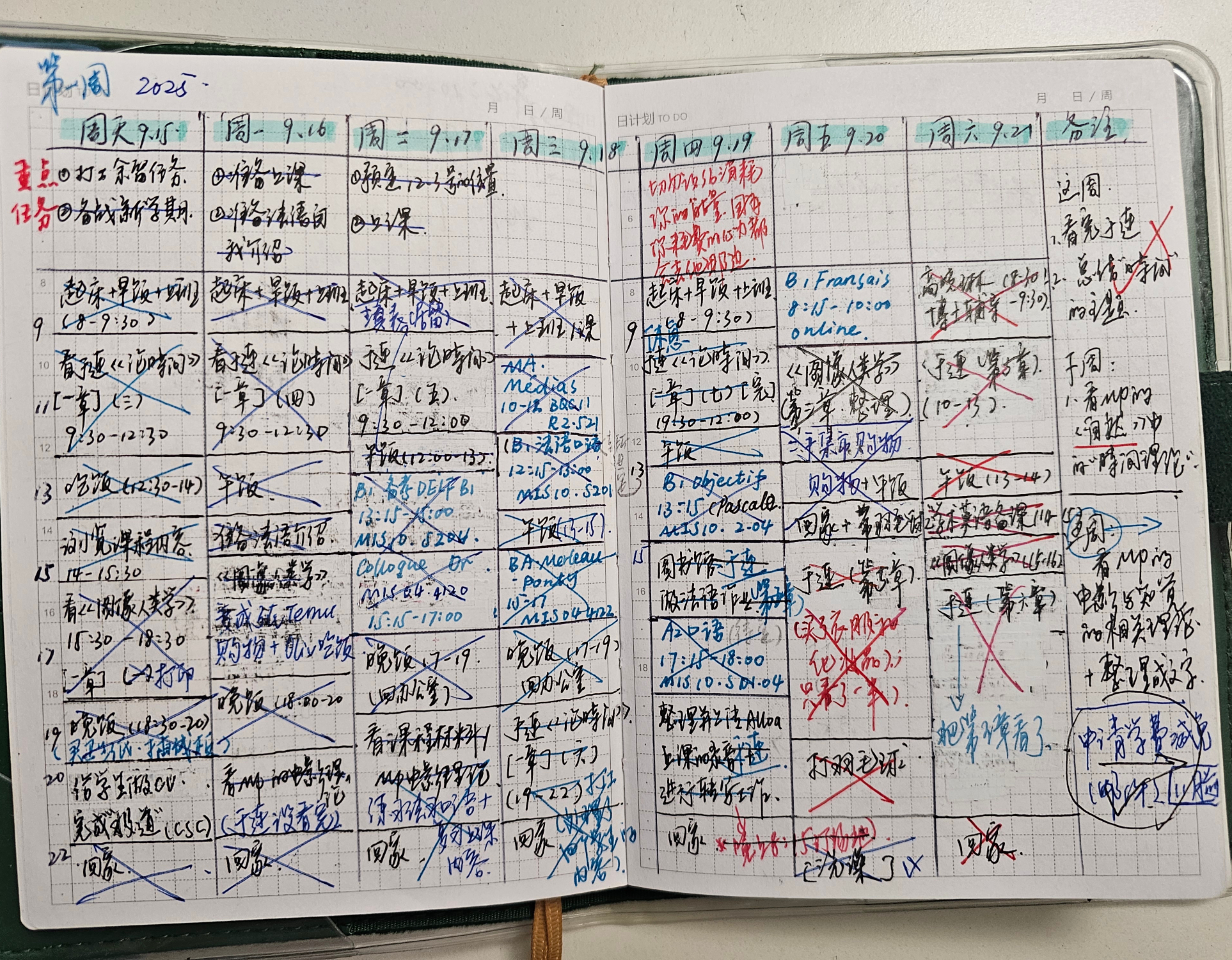
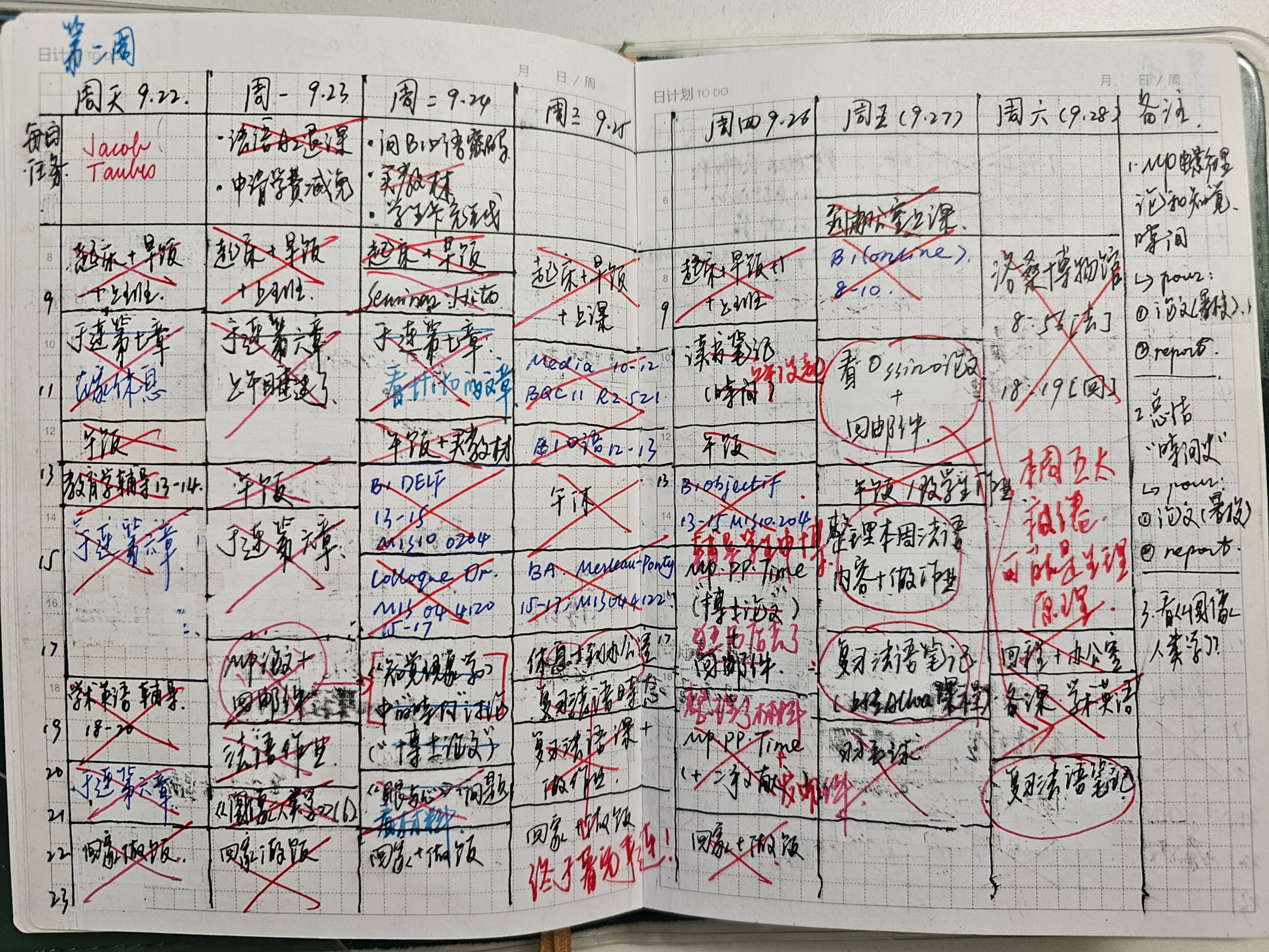
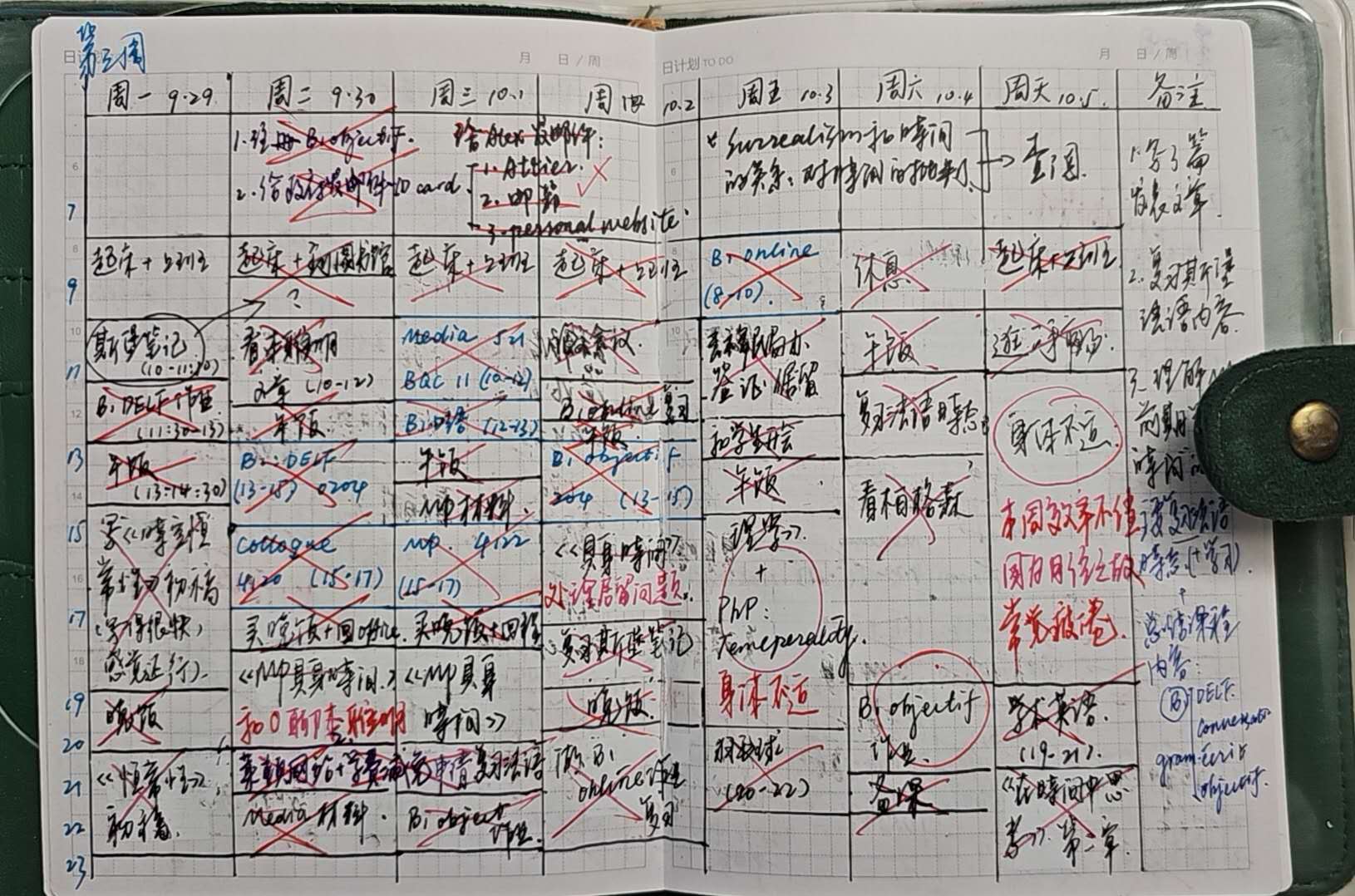
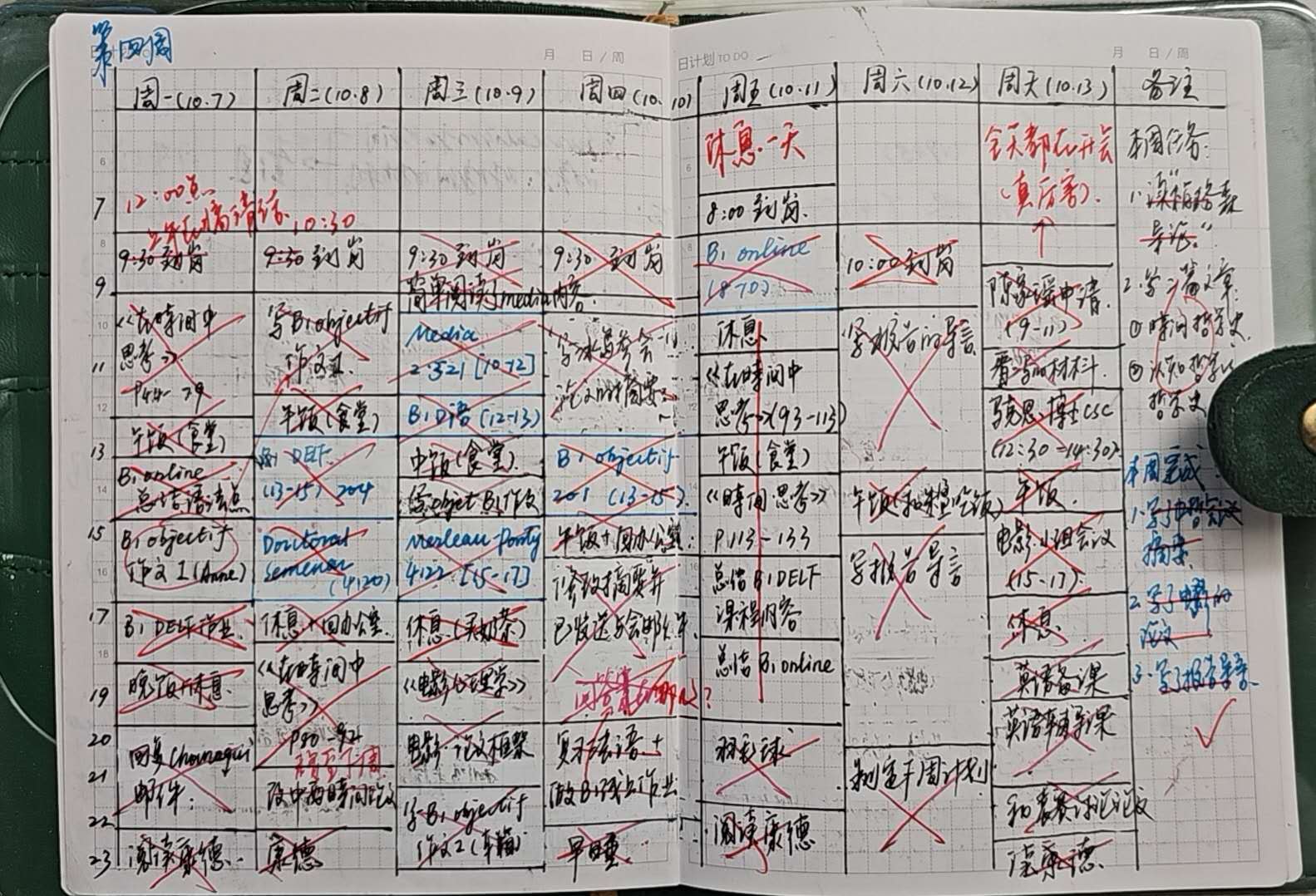
.
.
“My Space, My Rules” — From Time Management to Calorie Management
01/31/2026 Swiss
I’ve gradually begun to feel that my life is back in my own hands again. It’s a wonderful sensation—and I honestly can’t remember the last time I felt it. Maybe I never truly had it before? Or perhaps there were similar phases. I recently came across my schedule from 2019: a massive Excel spreadsheet. That year, every Sunday evening, I would plan the coming week hour by hour. Some things didn’t get done on time, but looking back now, none of that seems to have had any impact on where I am six years later.
I had been making weekly schedules since 2018, though unfortunately never stored them in a single, unified document—otherwise the archive would be quite impressive. Then suddenly it was 2025, and I found that I no longer needed such detailed planning to regulate my life. All I needed to do was go to the office, sit down, and write. Writing is full of contingencies: it can’t really be planned or controlled. But that’s precisely why I love writing philosophy. Arguments are always risky; they demand constant revision, correction, and repair. It’s a genuinely beautiful process.
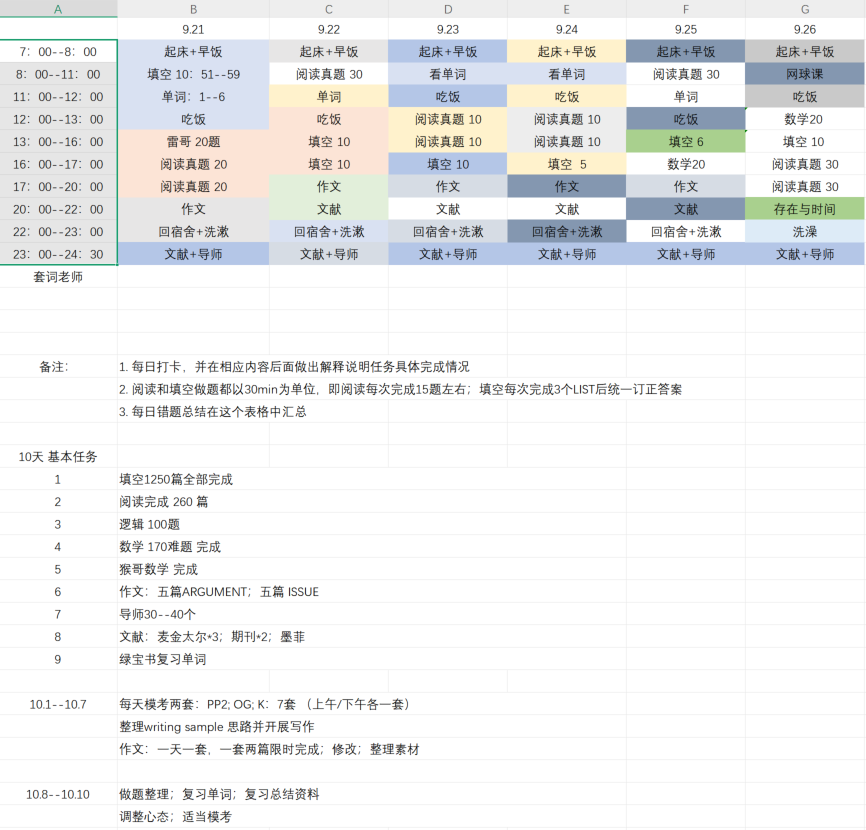
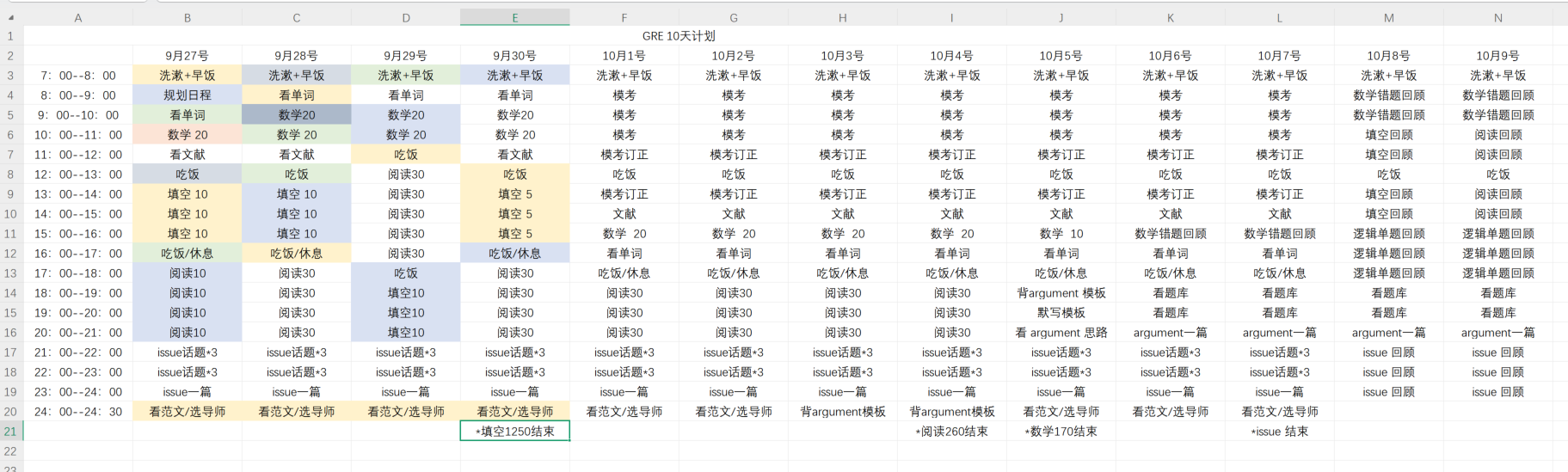
Since the end of 2020, my life gradually stopped revolving around myself—and that was not a good thing. What’s worse for the past, but nice for the present, is that I only truly woke up to this quite recently. Still, there were pros and cons. I became very adept at sensing what others were thinking—what my professors liked, which arguments appealed to them—so during my master’s program I didn’t actually need to push myself very hard. I even skipped classes and still ended up with excellent results. That was, at least academically speaking, a small silver lining.
In everyday life, however, I began to feel afraid of other people—especially those who gave me a bad feeling at first glance, the so-called “bad” ones. Regardless of what they’re really like, why should I be afraid of them? It suddenly dawned on me that they cannot harm me, nor can they change me—and their judgments of me have nothing to do with me at all. This realization has been crucial. Only when I stopped fearing potential conflict, stopped sacrificing myself to avoid it, stopped compromising my interests and wasting my time, did I feel a sudden sense of wholeness.
Perhaps because my family environment was so supportive—my parents’ work was respected—I never felt, throughout my childhood and even my university years, that I needed to protect myself. I never had to consider what would happen if someone tried to hurt me, because in reality they simply couldn’t. It was only after going through an intimate relationship saturated with lies and ending in betrayal that I realized I could, in fact, be hurt. The end of that relationship felt less like the loss of love and more like the completion of an entire degree program: after five long years, I finally graduated. And now, five years later, I can truly say that I am capable of protecting myself. I should be proud of that.
Growth, for me, has meant finally admitting that I can fail, that my choices can be wrong—while still knowing that I possess the ability to protect myself. I know who I am, what I can do, and what I ought to do. As the second half of my second year of the PhD is about to begin, I’ve already scheduled quite a few activities for the coming semester. After nine years in this field, the professional path of philosophy—of academia—has finally opened itself to me. I don’t quite know why I’ve been able to do this for so long without growing tired of it. Perhaps it’s because it makes me feel that I’m still thinking, that I can still think. An interesting shift has occurred as well: where I used to actively submit proposals to conferences, I now occasionally receive inquiries from professors about possible collaboration or working together. These exceptionally kind invitations have played a major role in stabilizing my state of mind recently.
After returning from South Africa, I suddenly stepped onto a scale I had bought long ago but never used. The number on it genuinely shocked me. I had never been that heavy before. Although no one could tell from my appearance—my fat distribution is even and discreet—I could no longer allow my body to exist in my life in that state.
The day after that shock, I started talking to ChatGPT about a weight-loss plan, learning the basics of healthy living. I downloaded a calorie-tracking app and began recording the structure and energy content of every meal. The current plan is to focus on fat loss for six weeks, from February to mid-March, and then move on to body shaping after that.
That said, I do need to defend my earlier neglect of physical management. I truly didn’t have the energy for such meticulous care before. The reason I could step on the scale so calmly after returning from South Africa is that several crucial things had fallen into place: my research direction is essentially settled (my supervisor says it’s now a matter of execution), my prospects for a global academic career are realistic (there are already collaborative projects underway), and my quality of life and emotional state are good (a stable routine, very few emotional fluctuations). Once these fundamental elements were soothed, perhaps my subconscious realized before I did: it was time to pay attention to my body.
Around the same time, I also realized that I could no longer imagine staying with my red hair. This wasn’t an aesthetic shift, but a change in self-understanding. I no longer need exaggerated hair color to assert my presence. On the contrary, I need something more natural—something that doesn’t compete with my own existence for visibility. So after returning from South Africa, I went straight to the supermarket, bought hair dye, and dyed my hair back to a dark brown-black.
Suddenly I remembered that when I was seven, I put a huge wooden board in my room with the words: “My space, my rules.” Now I’m twenty-seven, and I can finally say it again—clearly and confidently:
"My space, my rules."
.
2025 Is My Gift
2025/12/30 17:54 Swiss
It is now the last second day of 2025. Since I’m going to a spa tomorrow, today is reserved for writing an annual reflection.
I haven’t opened my personal website in a very long time. From September until now, life has been overwhelmingly busy—how did it become this exhausting? Objectively speaking, what I did was “just” finish the first chapter of my PhD thesis; yet, at the same time, the overall structure of the dissertation finally took shape. I know this will be a very beautiful piece of research, one that deserves to become a book (even if it is not one yet—but I will work toward that). This framework carries too many secrets, too many memories that resist being neatly put into words, and yet must be preserved by me. In the coming years, I will not only need to be responsible for my research; I will also need to be responsible for my memory, and for our existence.
I truly feel that my life has become different in 2025. I started trying many things I had never done before: building a personal website, starting a video channel, planning my own trips… I began to trust myself again, and through that, cautiously began to trust others. Strangely enough, many childhood memories slowly resurfaced, and I even felt as though my childhood had returned to my life. The depression and frustration I once carried gradually receded. I am no longer cynical; instead, I feel gratitude, emotion, and thankfulness toward everyone who has appeared in my life. One day, I told A that people are like mirrors standing opposite one another—this is my philosophy. Perhaps it is because the people around me are so beautiful that I have finally come to feel that I, too, am not so bad after all.
This year, I bleached my hair for the first time in my life; walked in heavy rain for the first time; experienced, for the first time, the shockingly precise feeling of being understood; and, for the first time, clearly understood why I do not need to take responsibility for other people’s emotions… I also traveled to many places—so many that I cannot fully recall them without flipping through photos:
In January: Milan, Florence, Venice, Rome, Naples; and the Vatican.
In February: celebrating the Lunar New Year with friends in Basel; visiting classmates in Freiburg, Germany; then spending a few days in Paris.
In May: returning to Belgium to see friends; attending a philosophy workshop organized by a friend in Antwerp; then going to The Hague, and having spicy hotpot with friends in Rotterdam.
In June: attending a conference in Iceland.
In July: Prague, then Salzburg in Austria, and finally Königssee in Germany.
In August: traveling to Inner Mongolia with my parents; first attending a conference in Changchun, then another in Hangzhou.
In September: a conference in Paris.
From October to November: writing my thesis in my favorite office.
In December: Leiden, Utrecht, and Amsterdam in the Netherlands. The Musical Instrument Museum was truly a wonderful place.
Another reason I left so few written traces this semester is that I began regularly uploading videos on my personal Bilibili channel. Recording feels much more convenient than typing—though in essence, they serve the same function. Since my first video on July 7, 2025, the channel has grown to 2,811 followers. While the number looks decent, I don’t think it is what matters most. What truly matters is that I realized my visibility does not rely solely on recognition within academic circles. The research I am doing, and my own reflections, can also offer others space for reflection and even happiness. In this way, my existential anxiety was suddenly eased quite a bit (and here I must thank the friend who previously encouraged me to start this channel). At the same time, it felt as though an international horizon opened up before me. I know that wherever I am, I will be able to live well—as long as I can continue doing what I am doing now: philosophical research that I love, that I devote immense time to, and that I am finally becoming genuinely skilled at. Through this research, I can help more people.
https://space.bilibili.com/244936260
Just now, when I opened my Bilibili private messages, I came across a message that left me with very mixed emotions. She should be a former classmate from middle school. Her message read:
“Long time no see, lyx. I’m so happy to have come across you—it’s really been such a long, long time. Seeing you continuously working toward your ideals makes me truly happy. Back in middle school, I always admired you, even longed to become like you. You were so unique, yet humble and interesting; so knowledgeable, yet never arrogant—on the contrary, so approachable that it made me feel a little ashamed of myself. The first time I learned about The Big Bang Theory was from a T-shirt you wore; the first time I realized that a little girl could write such bold, free-spirited handwriting was also through you. Back then, I used to wonder: where would you go in the future? What kind of person would you become? Would you enter the fashion industry? Study philosophy? Become a screenwriter?
Now, listening to your latest video—hearing you speak slowly and carefully about your semester’s experiences and reflections—I felt a deep sense of relief. You are still pursuing what you pursue, still walking your own path. In the years when I have been swept along by lies and by life itself, I have always kept a small corner in my heart where I would occasionally think of you, hoping you were doing well, walking the road you loved, even going as far as possible on it. I’m truly very happy. Perhaps you appeared by chance, but you gave me some strength. I, too, must continue walking forward. Wishing you all the best, and good health.”
This is truly a great gift. I still cannot remember who she is, and she did not tell me who she is either. Yet how is it that she remembers so clearly those dreams of mine that I myself have almost forgotten? I feel as though I should have cried—but surprisingly, I did not. This person, who is still a stranger to me now, has actually known me for fifteen years. Fifteen years! And she still remembers so many details about me. I don’t know what to say. I don’t even know who she is. I feel a hint of guilt. But no matter what, if I gave her some distant strength, then perhaps I did do some things right.
Since early summer, I have almost fallen into a kind of “obsession” with the motive of self-understanding. For several months, I even needed to have very intensive conversations with ChatGPT or DeepSeek—sometimes disappearing into them for two or three hours at a time. At first, the reason for these conversations was not to understand myself, but simply to grasp the inner logic of other people’s actions. Yet unexpectedly, in the process of making sense of many complex situations, I saw myself—more and more clearly, more and more fully. From a perspective I had never had before, I rediscovered myself. Through the significant other, I saw myself again!
And this, too, is a gift that 2025 gave me –My gift!!!
.
From Prague to Salzburg: I know what I want, and I want it hard
2025-07-23 05:04:45 Czech Republic
It’s now 7:30 in the morning. I’m on a train from Prague to Salzburg. I stayed in Prague for two days—only two days, yet it felt much longer. I had taken an overnight bus from Munich, slept no more than three hours, then checked into the hotel and immediately went back out to write. Many tasks remain unfinished. Even now, on the train, I should be writing, but instead, I opened this journal.
Everything I know about Prague comes from Milan Kundera—not Kafka. Although I’ve only read a few of his books, he remains one of my favourite writers. He is direct, intelligent, humorous, sharp, and somehow still human. His books are filled with untimely jokes, and he describes the various performances of human life with both delicacy and detachment. People willingly “perform”—and that, perhaps, is the very foundation of human society. It’s the same for me. What matters most, perhaps, is finding the “right audience.”
(Take, for example, my two supervisors. The more time I spend with them, the more I find myself genuinely appreciating them. Supervisor A is highly efficient, incredibly intuitive, and speaks rapidly. I’ve started to imitate his “intelligence,” becoming stricter with myself—as if I were borrowing his eyes to judge my writing and academic life. Perhaps the greatest gift a mentor can offer is not knowledge, but a demonstration of effective, grounded competence. The PhD stage is no longer about accumulation; and now, with AI, knowledge itself is easily accessible. What truly matters is learning how to be a person, a scholar, a successful scholar—and observing them has become my starting point.
A rather funny moment occurred during one of our earlier conversations. He insisted that I refute him on the spot. In that moment of exchange, I seemed to agree with everything he said—but he could tell I was holding something back. He “forced” me to share my counterarguments, saying that this is what philosophy is all about. Yet at that moment, I still couldn’t respond. Later, however, I went through all of his arguments, carefully restructured them, and integrated my objections into the revised research proposal I submitted to him—he was somehow pleased. But the moment of refuting means a lot: my confidence about my opinion, my willing of sharing, my openness to criticizing, etc. I should learn to communicate in such an “aggressive” but efficient way. )
Prague, to me, was emotionally complex. On one hand, it offers much to admire and plenty for tourists to see (Kafka, Mucha, and the like). On the other, it feels strangely simple—precisely because it offers only those lovable things, those things made for visitors to love. I bought two small souvenirs: a mole plush fridge magnet and a keychain. Incidentally, “The Little Mole” was originally created in the Soviet Union. Strangely enough, I seem to have a taste for all things Soviet. In Berlin, my favourite neighbourhoods were the Soviet blocks. A kind of inherited complicity with socialism? I don’t know.
In Prague, conversations with a friend helped me figure out a few things—especially what I really want. (People have been asking me this recently. Is it age?) Finally, I could say to myself: I know what I want, and I want it hard without effort. What I may need is simply a companion—not someone to constantly share emotions with (I honestly don’t feel that many emotions anymore), but someone with whom I can work, build interesting “projects,” and achieve things. Affection or love can only emerge from meaningful interaction and sustained evaluation. Oli told me two months ago that love, if it is to be genuine, must always carry high risk. Still, I must reduce that risk within a controllable range, and strengthen my capacity for self-protection and self-repair. No matter what story unfolds, what I need most is a stable inner state and space for solitude—that’s where my subjectivity truly takes root.
Also, the recent scandals in both academia and the entertainment world have left me stunned. In those fleeting moments of reading the latest headlines, I’ve even felt a trace of sorrow. Humanity, as a collective, seems so pitiable—trapped in its own desires, in the gaze and expectations of others, in the rigid norms of society. And none of this is really within my control. I’m just one of the many pitiful ones. Life is beautiful—but the hardships of living often try to make us forget that.
Still, despite all this, I feel happy. That’s what Prague gave me. In the Old Town Square, I stumbled upon a Salvador Dalí gallery. I decided to go in within a second and asked my friend to wait at the bar downstairs. Dalí has been my favourite artist since 12. He’s the very image of delightful chaos. In his dreamlike paintings, all fixed meanings dissolve. Those are the rare moments in which I can escape from “language.”
One morning at the hotel, my friend asked me why I obsessively arrange all my belongings in order, almost compulsively. I suddenly realized: my sense of subjectivity has, at long last, been restored. Since I was 21—during my exchange semester in Taiwan—I couldn’t sleep unless my desk was perfectly tidy. But after I moved to Belgium, due to a flood of emotional turmoil, I stopped caring about my room. My mind and my mood were chaotic. That interior disorder became external. I remember that semester in Strasbourg, when I couldn’t even bring myself to do the dishes. My thoughts were not with myself; my time was consumed by a story with neither beginning nor end. I never want to feel that way again. My life must be mine.
Fortunately, since last semester, I’ve resumed making my bed, restoring order in my room, caring again about cleanliness and clarity. Back in Belgium, when friends stayed over, I would keep using the same sheets and bedding they had used. But now, I habitually clean everything after someone touches my things—because what is mine must remain mine.
.
A Serious Play
2025-07-23 05:04:45, Germany
Right now, I’m sitting at an Italian restaurant next to the Munich train station, waiting for the overnight bus to Prague. This afternoon, I took a seven-hour train ride from Switzerland to Munich. On the train, I worked intermittently on the paper I’m preparing for the Paris conference in September. I feel genuinely good—finally, the writing has reached a breakthrough. After getting off the train, I even gave myself a little compliment.
Overall, July has been a beautiful month. One thing followed another, yet everything seemed to move forward with a kind of self-sustaining rhythm. Even while traveling, I’ve been able to find time to write and to reflect on small problems as they arise. I now enter a working state much faster than I used to. Once I step off the train, I deliberately set aside those scattered thoughts and let myself immerse fully in the pleasures of the sensory world.
Earlier today, while waiting for the bus, I looked up and saw a large tree. Some of its branches had broken off and healed over with rough knots. Last night, walking home, I noticed rain-speckled leaves—smooth in texture, but lined with serrated edges.
A few days ago, a friend from Leiden came to visit Switzerland, and we went hiking together. On the trail, I kept asking him about Nietzsche’s theories. I’ve been particularly struck by two notions: the “will to power” and the idea of “play.” The last time I read Nietzsche was the summer before I graduated from college. Each day, I’d go to the third floor of the library, sit by the window, and read Beyond Good and Evil. I scribbled notes on nearly every page (which, admittedly, was an act of vandalism against a public book). Most of those notes I no longer remember, but I’m surprised by how deeply Nietzsche has embedded himself into my very way of being.
Nietzsche’s idea of the “will to power” is not about concrete domination—it’s about how one might integrate a diversity of desires into a coherent life. Our lives are fragmented, full of contingencies—yet there seems to be a force that gathers them, brings them back into a kind of unity. Life becomes a game of self-regulation and self-assessment, a game whose rules demand perpetual “self-overcoming.” And if it is a game, it implies both rules (some socially and culturally imposed) and freedom (I have absolute control over how I play, and I can question all given rules without blind submission). But precisely because it is a game, I must also play it with seriousness and rigor—only then does life become truly joyful. Once life begins to self-organize, the very concept of subjectivity becomes both a necessity and a fiction—because in truth, I could become anyone, if I so wished.
Lately, I’ve realized that it took me four years to fully admit to the failure of a past decision on the relationship. But mere acknowledgment is not enough—otherwise, I risk becoming afraid of failing again, which leads to weakness in action and emotional paralysis. Failure itself is not frightening. What matters is that I construct a new kind of protective system after failing—but not one that numbs me or prevents immersion. It should not be an “anti-addiction” mechanism that suppresses my ability to wholeheartedly experience emotional flows. Rather, it should be a system grounded in “possibility”: I must always be able to walk away from any game, yet also be fully willing to participate in it with all of myself.
It’s like when I was searching for a PhD advisor. At first, I stubbornly fixated on the one person I thought was perfect for me—and that left me in a half-year spiral of anxiety. But after I let go of that imagined “uniqueness,” I suddenly reached out to four other outstanding professors. It wasn’t that having more options made me feel secure. Rather, it was the existence of such a defensive structure that allowed me to pursue my goals calmly and steadily.
Looking back on all of this, perhaps the essential task is not how to deal with failure when it happens, but how to pre-acknowledge the possibility of failure and prepare a positive form of defence in advance. Only then can I devote myself entirely—with courage and energy—to the best option I believe in. In that sense, “security” is something I must grant myself. To place hope in another is not only unreliable—it may not be a remedy at all.
My Soul Still Lingers in Reykjavik
2025-07-05 03:36:28 Swiss
A conference brought me to Iceland for a week at the end of June. I have been back in Switzerland for four days now. I have no motivation to study. My soul did not come back with me. It remains among Iceland’s primitive tundra and glaciers.
Ten years ago, I wanted to come to Iceland. It was because of a song called “Reykjavik” by Juno. The lyrics went: “Still I trap myself in empty dreams, the unextinguished passion broadcast for ten years, like a hot spring gushing into a cold ice cellar. In the battle of hot and cold, whoever has patience wins, frozen old love thaws again. (還是 我自困 空想之中,未熄的熱情 用十年來放送,彷彿一眼熱泉 湧進 寒冷冰窖中,炎涼大戰中,誰夠耐性便勝利,冰封舊情再解凍。或者失約 一早已在你 預備中。堅守冰島只是我 未望通。根本不是 天下情人都 求重逢 重溫美夢。情人都 求重逢 重修破洞,如情人都 能重逢,情歌少很多 精彩內容)”
“The unextinguished passion broadcast for ten years.” Ten years ago, I was just starting high school. I never imagined I would actually be in Reykjavik ten years later. On the first day, walking alone past the art museum, I felt supremely happy. I had really come to Reykjavik! This was the first time Iceland saved me. It helped me fulfil an adolescent expectation and let me feel again those years that flowed like a fresh river. It allowed all the unfinished, unrealized regrets to take another form and continue to dwell in my life. This made me feel happy.
The trip to Iceland was too perfect. I don’t know where to begin recording it. On the first day, my friend and I signed up for a day tour to the famous Golden Circle. The bus drove steadily on the highway. Tundra, grassland, glaciers, volcanoes–but always empty of people. Perhaps from that moment, my soul was stuck to this island. Enormous waterfalls cascaded down from patches of green. People are too small, too powerless. But I like this feeling. Hot air rises constantly from the ground everywhere. The earth is alive.
Days two and three, I attended the conference. After my presentation, three friends asked me questions. This was good. During lunch at the conference, I sat with a group of strangers. They were philosophy professors from around the world. My presence at this table was pure chance. But during our conversation, I suddenly realized one of the professors was a teacher for the philosophy summer school I had applied to this year. I chatted with her briefly and learned some inside information about the selection process. After lunch, I found another German professor she mentioned and introduced myself. Though he said the competition was fierce, he had me write my name down for him directly. Yesterday I received an invitation to the summer school. I don’t know if those few minutes of casual conversation made the difference. It felt like I was playing a single-player game, collecting clues from different people, completing tasks, then unlocking new scenes.
On day three, I asked Professor He, who studies the “I Ching”, a question at the conference. During the break, quite by chance, I chatted with his doctoral student. The student was German but spoke good Chinese. He said he was returning to Germany the next day and couldn’t take Professor He, whose English wasn’t good, on a tour. I said, my friend and I are going to Iceland’s south coast tomorrow, why don’t you join us. He agreed.
On the fourth day in Iceland, my friend, Professor He, and I boarded the tour bus together. I’ve always been very interested in the “I Ching”. This was one important reason for my invitation. Another reason was that Professor He, though nearly seventy, was spirited and upright, handsome and quite talkative.
On the road, I chatted with him about fortune-telling. I told him many stories I knew of fortune-telling that was remarkably accurate, even frightening. This was showing off my meager skills before an expert, since Professor He is a famous Feng Shui master in China. After hearing my anecdotes, he was silent for a while. Then he told me he had visited Iceland’s “lava museum” a few days before. The lava there was so realistic that people might think they were surrounded by actual lava. Our sensory world is much like this lava performance. What we see and hear, what we listen to and feel, is not absolutely real. We simply choose to believe it so. Perhaps we will finally discover the world is virtual.
Later we reached another waterfall. On the way back to the bus, he asked if I could explain phenomenology in the simplest way possible. Why “simplest”? Because he said his colleagues’ explanations weren’t very clear to him. I said phenomenology is really about explaining how we touch a cup, how we see an object. I think the “I Ching” or traditional Chinese philosophy might start from grand but accurate “intuition” and reason down to the specific, personal self and life, while phenomenology starts from extremely minute perceptions and reasons out the organizational pattern of all nature, even the universe.–These two paths must meet at the same point. He seemed quite satisfied with my answer. This made me happy too, because I clearly felt my progress. Four or five years ago, I couldn’t have given explanations that convinced both myself and others.
Almost every night in Iceland, I went alone to see local free live music. The first day was punk, the second day I went to the “punk museum,” the fourth day I went to a rock show, then moved to another bar to watch DJ and drum performances, the fifth day I saw the last rock show, leaving before it ended to catch my flight back to Switzerland.
These brilliant performances were the second time Iceland saved me. For the past four years, I had been writing the same story repeatedly, like a compulsive repetition. I was always talking about how I was loved, deceived, abandoned, blamed, and so on. In those years, I had lost interest in many things, including music, which I used to love most. I seemed castrated, having lost interest in and love for the world. These were all self-imposed prisons, but I could only spend those long four years this way. Like cutting out rotting flesh, new flesh needs time to grow and fill the wound.
However, those nights in Iceland formally let me say goodbye to all the past. Like a person with a broken bone finally removing the plaster cast. True freedom and vivid subjectivity returned to my life–undoubtedly a tremendous gift. I thank myself too. Through constant study and writing this year, I had the opportunity to come to Iceland and complete this journey like a farewell ceremony. I also thank myself for being kind to people, allowing me to meet good teachers and friends who led me out of layers of confusion and difficulty.
My strongest feeling in Iceland was “I am happy, I am truly lucky.” At the conference, I asked Professor He a question: Is the historical pattern linear or cyclical? He said many things I can’t quite remember. But he said although the “I Ching” can predict future directions through various historical facts with around 60% accuracy, what keeps us away from “determinism” is the giant “nature”–this is where infinite possibilities lie. During these days, I mysteriously met a Taoist priest online who said he could help me pray for smooth romantic fortune through ritual practices, as it was the largest challenge in my entire life. I hesitated only a few minutes before paying the considerable fee. Funny fact is that I only questioned whether he was a fraud; I never doubted whether the ritual would have its claimed effect.
My recent research topics are “narcissism” and “mirror phenomena,” which have very close logical connections. When I smile at the world, it smiles back at me. When I trust it, it trusts me. I seem to realize that trust exists not only between people, but also between a person and their own fate. When I believe I deserve a better future, I have the courage to walk toward it.
Well, I think it was necessary to write this journal. These days after the trip ended, I was always distracted. Like someone holding their breath, unable to concentrate on work. Writing this journal is like “breathing.” Okay, now, I finally had time to write this journal, so I should be able to continue my work.
Today, on the way to the office, I recalled my first year of doctoral study. There were quite a few achievements: three book articles, two international conferences, two domestic conferences, one journal article, one translation article.
July’s tasks remain heavy: 1. Finish the online course on the “Tao Te Ching” (average two lessons per day; because I want to continue studying the “I Ching” course, I need to accelerate); 2. Finish the paper for the Paris conference by July 14; 3. Begin translating my supervisor’s work in late July; 4. Exercise 20 minutes daily.
Looking Back A Little Bit
2025-06-20 20:03:34 Swiss
1. The Emotion Problem
This is my fifth year in Europe. I have grown “steady.” Last week I was editing a collaborative paper and wanted to curse. When my friend walked over and asked how I was doing, I smiled and said, “I seem very angry right now.”
When I graduated from college, I was the kind of unstable person who would storm into the dean’s office and argue with him because I disagreed with the school’s evaluation policy.
The first step in controlling your emotions should be to quickly recognize what you feel. Then you can pretend nothing happened. Don’t be greedy. Accept whatever life gives you. Allow everything to happen. Whether it’s what you expected or not, recognize your emotions quickly. Control your immediate emotional reactions. Accept reality again, seriously.
But is learning to master emotions lucky or unlucky? That’s another question to think about.
The result is that I handle my suppressed emotions by ten-seconds screaming in the office at night. I sing on the road while cycling at midnight. Then I go home. Everything is calm again. Nothing happened. But sometimes the emotions build up to a certain point and become a good cry. After crying, it seems fine again.
Anyway, peace of mind is the most important thing.
2. The Ranking Problem
Tonight I was smoking secretly by the office window. I suddenly thought about ranking “purity, diversity, and intensity.” (Indeed, another case of inexplicable overthinking.) But I really ranked them: purity > intensity > diversity. Keep everything simple in life; Then you can have high-intensity events; Events solved quickly and well can bring diverse events with intensity. If it were the other way around, it would be the worst. Haha.
Today while writing the paper, I kept thinking about the logical order of trivial matters. (Maybe my OCD was acting up.) I did academic writing while listing the causes and effects. This is probably a benefit of ADHD. Being able to think about several things at once. Maybe it’s a habit I developed from watching TV while doing homework as a child. Fortunately, today I was doing simple text writing. No key concepts to understand.
On the bike ride home today, I found that overthinking might affect action. So recently I started reading and writing some political philosophy again: making decisions and doing acting at the right time. (Good news is that my paper on Carl Schmitt’s political philosophy was accepted by the phenomenology conference a few days ago.)
If it’s not something that requires a decision, should I let them maintain a “quantum superposition state”? Do I actually like this superposition state, or can I not face the consequences of reality “collapsing”?
Also, yesterday I finally admitted my parents are really very good parents (perhaps, the present can modify the past). They never interfere with my decisions. As long as they’re reasonable, they support them. But this might also be because my decisions are all reasonable decisions. Or they are very confident in their education since they think that under their influence, I won’t make outrageous or stupid decisions.
(Except for a period in my sophomore year of high school when I wanted to drop out to study painting as my profession. They objected and analysed the pros and cons with me all night. In the end, I agreed with their reasoning and gave up the idea.)
3. Writing Experience as a Collaboration Problem
Having a personal website is really nice. I don’t have to write journals on websites I don’t like anymore. They don’t have the styles I prefer. I started writing diaries in notebooks in 2016. In 2020, I even brought my diary with me when traveling. Later, because there was too much to record, I simply switched to the internet. A while ago, I flipped through my reading notes from 2017. They were quite touching. Actually, my core hasn’t changed much—this is also a very good thing.
Professionalizing philosophical work might really make people more picky and controlling. Ihave to ensure the accuracy of every sentence. It must also fit my philosophical aesthetics and literary taste. Therefore, sometimes I can’t stand other people’s “messy” arguments. This is especially obvious when collaborating on papers with others. I have to revise every sentence until I’m satisfied.
This also makes me realize the importance of choosing the right teammates. If my colleagues also had control issues, they might not be able to stand my large-scale cuts. Fortunately, they are relatively lazy and didn’t mind my major adjustments. If my teammates had the same “cleanliness obsession” with words as I do, we couldn’t collaborate; If they have an indifferent attitude, although my workload increases significantly, the final result will satisfy me.
(I suddenly noticed that my sentences are getting shorter. Is this also a kind of mental state change?)
4. Academic Activities as an Interpersonal Problem
Yesterday I received an email from the professor. He said he was very satisfied with my editing work and co-authored papers. At the same time, I suddenly realized the benefits of collaborative articles: I could never write such interdisciplinary research papers alone—film theory, experimental psychology, neuroscience, philosophy—perhaps this is also a gift brought by coincidence.
I think back to meeting everyone at summer school last year. We had eight days to get to know 30 students from around the world—undergraduates, masters, PhDs, postdocs—and then form teams freely to write articles together. So this game was not just an academic exchange occasion, but more of a social occasion. How to use your research topic to attract strangers’ interest and make them willing to trust you, work together and discuss.
In the end, I participated in the research of three groups. Besides being good at philosophical argumentation, I also had to be happily open to myself, communicate with people positively and kindly, and finally gain teammates’ trust. On the contrary, I noticed that some people seemed too introverted or too arrogant, so they didn’t even participate in a group or formed their own group. I think this was not a problem with their research ability, but ultimately a character problem.
.
The First Day of Being Twenty-Seven
2025-06-19 21:45:17, Swiss
I’d been planning to build a personal website for months. The site finally went live on my birthday—a gift I’d prepared for myself.
What surprised me was how many friends sent birthday wishes this year, from those I’d known just a few months to those I’d known fifteen years. Some friends I never even remembered telling my birthday. I felt deeply happy and lucky.
I’d been busy lately—chapter articles, conference submissions, paper revisions, translation work. I hadn’t really wanted to celebrate my birthday, but LI invited me to her place. I left in the morning. Google Maps said twenty minutes by bike, but it routed me through the entire forest near my appartment. I pushed my heavy bike through the forest for over half an hour. Just as I emerged onto the road, two or three garbage trucks passed by. The stench and blazing sun nearly made me almost vomit in the roadside grass. I closed my eyes for five minutes, waited for the smell to fade, then continued riding.
I finally reached her place after an hour. We ate udon noodles and a small cake she’d prepared. I saw sparkler candles for the first time. I was really happy. She asked if I felt lonely, constantly traveling abroad. I said I was probably used to it by now. Good friends always stay close in unexpected ways. We talked about “romantic relationships”—she was shocked and disappointed by my years of “hesitation” and “silence.” She said, “Good boys and good girls don’t end up together. That’s why good boys always end up with bad girls, and bad boys always find good girls.”
I went to the office in the afternoon, couldn’t focus on studying, and continued working on the website. I looked through many old photos. I’d been to many places, met many people. That evening, after LI finished her exam, we had dinner together at an Italian restaurant in the old town. I ordered pasta, she ordered pizza. She also bought me a cocktail—mango, passion fruit, orange, and grapefruit flavored. It was really good! After that, she took me wandering around the city, hoping to find a party—a dancing party. I told her I’d never been to a dancing party. She was shocked again. We circled the city and came back empty-handed. I said goodbye to her at the bus stop at eleven-thirty.
On the bike ride home, I heard someone calling my name. It was Al and Ya, two friends I’d met about a month ago. I told them it was my birthday, and they congratulated me. I told them my friend and I had just searched the city for a long time without finding a party. Al said they’d just returned from a student party. After some conversation, Al and I went to a lively end-of-term celebration party. I rode his electric bike. Electric bikes are nice—I thought I could save money to buy one in the coming months. Though we went to the party, we sat on a bench under a big tree away from the crowd. He started talking about some romantic confusion. Being young is good. While trying to understand him, I also remembered many people and things I’d encountered over the years.
But, I suddenly found a reason for my “silence” and “inaction”—I needed to feel “safe”! So, very fortunately, in the first hour of the first day of my birthday, through this accidental encounter and conversation, I forgave my apparent “incompetence.” First, being alone in various European countries (Belgium, France, Switzerland, Netherlands) wasn’t easy. The feeling of drifting didn’t always mean freedom and liberation—it basically meant I needed to be stronger and even more independent.
Second, I’d already been hurt once, by one of the people I’d trusted most. I had good reason to protect my sincerity more carefully. I couldn’t help being afraid of commitment—both others’ commitments and my own. If I committed, I would definitely work to build a future, but were others’ commitments reliable? Were they people who could make commitments and not betray them? These were things I had to consider. Of course, I couldn’t keep being afraid forever. Being capable of hurt only means our hearts could still feel “love” and still expect “love.” Like the sentence that suddenly came out when I was talking with Al: “bad things are only the appearance of good things.”
People should know what they want. For me now, I suppose, many things require the quality of “loyalty”—to oneself, to others, to career. Over a year ago, in the acceptance letter my advisor sent me, he asked me again whether I was willing to give my research a “commitment.” I emailed back: “Absolutely!” I hadn’t realized then that this commitment would become an important motivation for my persistent studying and writing this past year. I’m not wildly ambitious—I’m just responsible for the path and career I’ve chosen. Isn’t this the quality all good relationships need?
I’m not sure if such thinking is too serious. But I think we and the world are like mirrors facing each other—we smile at it, and it smiles back at us. We treat every person and relationship seriously, and they treat us seriously in return. In this seemingly convenient age, everything—eating, dating, marriage, healing—seems to be fast-forwarded. But what remains in life’s long river are only the heavy, stubborn, enormous stones. Of course, the years will leave us deep love, if we are a great river and not a small stream.
.
Missing a Band’s Singer
2024-01-20 10:19:36, France
It’s been a long time since I heard news of them. They were long entangled with my boring college years. And now I’ve completely bid farewell to my college time, because I also seem to have gradually emerged from those days of genuine heartbreak and bankruptcy. Inexplicably, I now suddenly and especially miss those days of loving those reckless lyrics:
“Can you be the scar I wake up with after drinking / not knowing where it came from / just consider it a jasmine flower / blooming in our wasted time / Can you be the cartoon I can’t bear to turn off / before dawn / even if I can’t watch you all night / you don’t have to worry about becoming boring / Can you be / just be everything all / all all all everything everything everything all / all those unknown truths / only by giving up the pursuit can you see them / What a beautiful jasmine flower / fragrant and beautiful covering the branches”
How beautiful this song is.
.
Ordinary World/Nothing Matters
The ordinary world only needs me to wholeheartedly do one common job, nothing more. And what I want must be obtained. I must be responsible for this work, with a sense of responsibility, not just for happiness. This is my promise to myself. I must take this difficult thing seriously because this thing is worth my pursuit. It will not only profoundly change myself but also affect others. This contribution might possibly belong ultimately to humanity’s cultural river, to my friends and descendants. Even if it’s just that almost negligible wave, I’m willing to contribute most of my time and constantly running mind for this tiny ripple. This is a new era that needs new enlightenment. And I am merely one of the megaphones among the ruins of the past calling for fresh life. In this era of rapid progress, I think it’s necessary to look back at the dust in history, in order to continue forward with ancient vitality, to continue proliferating.
.
Two Become One/The Taste of Combination
2023-02-09 02:41:46 Belgium
Today I tied my hair up for the first time in a long while, just like every day before sophomore year, when I hadn’t yet cut off my long hair. Looking at myself in the mirror, I felt somewhat dazed. The way I look now isn’t much different from high school, except my hair is dyed deep red and slightly curled. I do look much more spirited overall. Actually, my mom’s advice was always right—this hairstyle suits me best.
I started teaching myself French today. I need to learn a semester’s worth of content in nine days to take the exam in the first week of school. The plan is three days to memorize vocabulary, three days to go through grammar, and the last three days to review and do practice problems. I can only charge ahead. In the past two years, I’ve intermittently studied some basic content. Though these nine days are very short, it’s not impossible to pass the exam smoothly. Either way, I have to study.
Today, during a study break, the moment I returned to my dorm after smoking on the balcony, I suddenly smelled the scent that permeated my parents’ office when I was little. Cigarette smoke mixed with the smell of leather furniture. As a child, I didn’t like this smell. I never expected I would become a producer of this scent. Perhaps this is adult compromise. Needing to rely on the momentary relaxation that cigarettes bring to overcome the hardship and complexity of the present time, needing soft black leather chairs to comfort a spine bent over desks for long periods. Facing life’s uncertainties, I need to push a stone of my own choosing up a mountain day and night, not knowing where the end lies. This anxiety was too difficult for my childhood self to understand, let alone experience.
While smoking on the balcony today, I looked at the trees outside the window. I suddenly felt that some people are like trees—rooting in one piece of soil, then slowly growing, habitually beginning to occupy the familiar territory beneath their feet. Others are like schools of fish in the sea, needing to migrate everywhere, whether due to the passive necessity of ocean currents or the active contingency of seeking food—they’re always experiencing different scenery. I should belong to the former. On one hand, it’s the nature of laziness and fatigue; on the other, it’s the ambition of stubbornness and persistence.
.
Cigarettes on the Balcony
2022-09-25 04:20:58 Belgium
The weather is getting colder and darker earlier. Recently I’ve been in the habit of smoking on the balcony after meals, two to three cigarettes a day. I started smoking at the beginning of the year, at a New Year’s gathering where a friend rolled my first cigarette. Afterwards I found rolling cigarettes enjoyable, so I spent less than ten euros on a smoking kit: foam filters, rice paper, and a pack of tobacco. At first I couldn’t inhale properly at all—as soon as I drew it into my body, I would cough uncontrollably. After about a quarter of a year, I gradually became familiar with that dizziness and stimulation, stopped coughing, and the degree of lightheadedness also lessened. As for why I wanted to learn to smoke, I don’t know. Probably to draw a clear line from my past self. To commemorate the self-consumption approaching death and emotions constantly driving toward decay—besides smoking, I also got a tattoo. I don’t know why I couldn’t imbue that pattern with meaning in what seemed like such a strongly symbolic event. Perhaps its meaning was too manifold, carrying too much of my imagination, desire, and sentimentality. It remains on my arm while maintaining a distant relationship with me.
Smoking on the balcony, sometimes the birdsong is very loud. Gazing at distant trees, yet I can’t see a single bird’s shadow. Where does such loud sound come from? Is everything just my hallucination? Of course not, I tell myself with a laugh.
This year has really passed so quickly. I remember receiving a friend’s call in early October—he said it was raining where he was, and I said what a coincidence, it’s raining here too. Two years ago now, I was preparing my doctoral application; two years later today, I’m starting to prepare doctoral applications again. But what I want to do, the topics that interest me, have changed dramatically. In these two years, the only thing worth being proud of is that I’ve really been seriously experiencing everything life brings me. Two years ago, I seemed to face the complex world with a blank slate mentality. Back then I wasn’t afraid—I would directly do whatever I wanted without hesitation. But now I know fear, know that many things aren’t so simple and plain. Therefore I can no longer speak and live so recklessly. And someone told me this is absolutely not cowardice, but requires greater courage—requires re-engaging with life in a self-aware and self-controlled posture. Living seriously.
As my last cigarette of the day was ending, I said to myself: “My life can’t be on autopilot anymore.” My life and I still maintain a difficult-to-bridge distance—I don’t naturally possess selfhood. I need to be responsible for it.
.
Flowers Bloom on the Shore/Bye Bye Almost Summer
2022-08-03 00:57:36 Belgium
Half the summer has passed like this. Everything gradually returns to a normal state, living peacefully day by day. Some people have changed from friends to strangers, others from strangers to friends. There are departures of the most familiar people, and also lingering traces of weak/most distant nostalgia.
Sometimes I can’t distinguish certain relationships, or rather I’m always unwilling to clarify them. Perhaps only my thesis needs to be neat and regulated—daily life doesn’t need the rule of concepts, nor is it driven forward by concepts.
Debussy lets melodies flow in the air, like moonlight spilling onto the sea surface, stirring up shimmering ripples. I think I can be more open, allowing everything to happen within a place, rather than being a container bearing weight.
Recently I like watching people in exaggerated makeup, similar to theatrical effects. Terayama Shuji’s gorgeous/poignant shots make my heart race. Those colorful eyeliner, bright blush, huge red lips, pale faces—all these can be possessed by ordinary people!
Why don’t people want beauty anymore? Why has beauty become the source of sin? Why has asceticism become part of consumerism, consuming people’s love for color, praise for flowers, rejection of azure/fresh green/bright red/… to the utmost?
Should a man who loves beauty exist? Or should he naturally exist? Loving beauty can be women’s nature—why can’t it be men’s? If men can’t learn to truly possess beauty, then isn’t their appreciation of beauty utilitarian and instrumental?
But even if women have the most natural pursuit of beauty, how can their pursuit of beauty not be eroded by functionality? When their beauty depends on certain value judgments, their utmost efforts are merely requests to share a piece of the pie. The discipline of women’s love of beauty has always been strangely pervasive throughout consumer society.
I only recently discovered that Guan Xiaotian released a new song in April this year. His songs are all amazing. The melodies are chaotic, the lyrics are also disorderly, but I just love them. When I hear him shout out the lyrics, I often want to throw myself down, then get up, then wait to be tripped by something else. This longing for pain is accompanied by fear of sadness—am I waiting for something or welcoming some coincidence in having no expectations?
One lyric goes: “My epitaph shouldn’t be about me but about you.” So I began thinking about the content of my epitaph for the first time. I think I should write down the names of all the people I can remember, then distinguish them by font size. My parents, grandparents, art teacher Mr. Xiong who was very good to me, teacher Jin who was my substitute homeroom teacher for one semester, those few friends I played with best in elementary school, my front, back, left, and right classmates in middle school, all those who taught me to love and be loved, to care and give after becoming an adult… Counting it up, what I need to write isn’t actually as much as I imagined. And those with whom I have tenuous relationships, I’m also willing to leave them a place in my death with appropriately small font.
Last November on a drizzly morning, I fell from my bicycle and knelt on the steps toward Paris. Blood soaked my stockings, but the black color hid them, including a deep wound. Now that wound has healed, but due to hyperplasia, it left a light flesh-colored protrusion on my knee. This is also a mark life has left on my body, right? Without this scar and the tattoo on the inside of my left arm, after removing the head, who could recognize this utterly ordinary naked body of mine?
Blanchot said: Once a person begins to wait, they begin to reduce expectations. I think I must try my best to live in every minute, persistently live in each narrow yet precious present moment. Then even if I have expectations, they won’t be strong enough to disappoint me.
.
.
ESSAY
The Birth of Kitsch / “kitsch!”
2024-01-18 09:35:32 France
Because I also paint and write from time to time, I’ve gradually felt the birth of kitsch. Especially when I repeatedly paint the same content in the same style, the desire to seek fresh expression becomes very strong. A force unwilling to be imprisoned and disciplined by my past ways of expression drags at my weariness. Once I adapt to a certain kind of expression, that expression approaches death. This is a real feeling. Similarly, when I spend a period only watching works by a single director, I can also sense the director’s laziness. Perhaps some would say that’s style, that’s XX aesthetics, but I think only the director himself knows whether he’s being lazy, whether he’s relying on inertial expression.
.
To Crush An Ant
How much force does it take to crush an ant? Almost effortless. But why do ants exist? What do they live for? If they don’t live for anything, if living relies merely on some inertia of life, can their existence be equivalent to non-existence? Does their life contain anything richer than life itself? (Of course this is an anthropocentric viewpoint.)
How much force does it take to crush a person? Almost effortless. But why do people exist? What does he live for? If he doesn’t live for anything, if living relies merely on some inertia of life, can his existence be equivalent to non-existence? Does his life contain anything richer than life itself? (Of course this is a nihilistic viewpoint.)
“Must one live for something?” “One must live for something!” “Why must one live for something?” “Not living for anything is already death.” “Why can’t one die?” “Because death means interrupting the interrogation of death.” “Why can’t this questioning stop?” “Perhaps because giving up is easy, while persisting is difficult.” “Why choose difficult things to do?” “Because difficulty provides meaning.” “So is meaning really important?” “Then why do you live?” …
Something was drowning him. He could look up and see that danger he had long premeditated. He thought, how could life continue without facing death? If he didn’t create some difficulties for himself, how could he gain the motivation to live? Fortunately, this predicament needed no external source—he only needed pessimism to pervade, and then he could often discover small pleasures amid the scarcity of meaning. Even if insufficient to dispel the fog, it was enough for him to savor for a while.
.
A Murder
Why could he never complete a murder? What made him afraid? Was the realization of purpose the end of meaning or the beginning of meaning? He suddenly lay down, deciding to pause thinking about these simple questions.
He said randomly, “Ah, I’m just a wandering occasionalist. The reason I believe in the contingency of everything is that I try my utmost to be sincere, because only this way can everything around me present itself in its most real form. If I successfully pretended to be someone else, even fooling myself and others, then what rushed toward me would become chaotic and couldn’t possibly be what I really wanted, right?” (But he had never quite figured out the boundary between stubbornness and sincerity, so he often seemed foolish.)
Today someone told him he had always lived in a vacuum, and being able to lie down anywhere like this was already life’s favoritism—not a gift everyone could receive. That person also said he should receive anthropological education, because he actually knew very little about what the real world was. In fact, he was afraid of entering the real world of life. The fortress he had built for himself was so high it even made others a little nauseous. Sometimes he acted on intuition, sometimes he used (imperfect) reason to stop actions he should have taken. If everything was constructed, wasn’t his persistent deconstruction of these institutions another kind of pathology?
One evening, he was also told: there was no such thing as losing control. Losing control was just another normal state different from the average state. Real life had no abnormalities, nor should it have standards. All existence was reasonable. But it seemed he could only truly experience life’s mysteries by encountering enough samples? Thinking this, he lay down again. It seemed safest/most comfortable in his own nest, where all his self-deception and prejudiced dullness were treated with tolerance. Such sincerity was actually without foundation. But how to find one’s position amid diversity? How to shape a non-relativistic self and worldview within tolerance and acceptance? If every word spoken had a listener, we were invaded when speaking. Our selves never seemed to belong to us.
.
Why One Can Refuse Suicide
“The world is absurd, life is suffering, existence is meaningless.” “Loneliness is an indispensable feature of human nature, one that is stirred by a contradiction existing between people’s ‘need to find meaning in life’ and their ‘awareness of the nothingness of the human condition.'” —Sartre
Don’t die, he told himself. But why could he not die? He then asked himself in return. The reasons for refusing death initially seemed not to come from within, but rather for the love of everything about himself, to prevent some people’s sadness. He thought that even if one person would shed tears because of his departure, then he shouldn’t die. Unfortunately, long periods of solitude had almost made him forget this point. He began learning to maintain a friendly yet safe distance from everything around him. Why love sometimes became a blade, he didn’t understand. Why in so-called love did he feel himself sacrificing, withering? The more he pretended to be numb and ignorant, the more deeply he knew his own deficiency, then maneuvered between desire and rejection. Dizzy and aimless, he began walking on every street that knew him, but he had never seriously examined the mottled and elongated earth beneath his feet. Like someone making fire in winter snow, only when cold descended would he actively approach the flames, but soon he was burned and returned to the precarious ice surface, beginning to hate that heat.
What he seemed to need was a greenhouse where he could run or lie down without restraint, forgetting day and night, ignoring the changes of seasons. Did some people really only deserve bone-cutting cold? Sometimes he suspected he was truly about to be forgotten by this vast world. On second thought, when had this world ever remembered him? Recently, he wondered if he should cede part of himself. If he was actively disappearing, excreting, or vomiting, then he wouldn’t plunge too quickly into death that was colder than cold itself. But an unlit candle was meaningless. As a translucent gelatinous cylinder, it could let itself drift on the river surface, in the center of a lake, even sink to the ocean floor—but then no one would ever know it was actually a candle.
Walking down the street, he thought of his mother and those people who treated him kindly, and some distant lives with weak connections to himself. So try to light yourself? He said to himself for the first time with purposeless courage. Such dedication was almost facing death. He imagined himself burning. He first saw his arms melting, bringing a glimmer of light to wanderers also deep in darkness. He thought he might imitate that Happy Prince: his eyes were plucked away, his skin peeled off, he lost his crown and rings, his golden clothes were torn away by beggars down to the last fiber, but thus he was truly scattered throughout the world (he would persist in places where he originally could not exist).
For a long time, he stubbornly believed he was about to die (the next second or tomorrow), between suicide and not suicide, between survival and death, melancholically gazing toward that horizon that had never belonged to him. Occupy a temple or burn it down. He habitually indulged in his yesterday, today, and tomorrow, but rarely seriously considered others and their time.
The reasons for refusing death could finally become internal. He realized that the ashes of his burning (if he were lucky) could freely float above the city, in suburban wilderness, even reaching endless highways and narrow forest paths. He had a premonition that he was about to begin real life, dedicating his entire existence by way of burning. At the same time, he began to have expectations—he genuinely longed for his own non-existence. Occasionally thinking of this, he felt a feather-light, subtle satisfaction.
Thus, he realized he shouldn’t die. In the unpeopled wilderness, he finally saw the first Other.
.
The Unjust Trial/Warrantless Sadness
To resist the pain that had once been fulfilling and was again hollow, he was forced to throw himself into a kind of closure. To refuse sadness, he refused the birth of all emotions, at the cost of losing normal associative and perceptual abilities. In numbness, hypocritical, false calm briefly appeared. He tried his best to escape, awkwardly, inappropriately, like a stray dog. He floated on the path away from memory. Melancholy emerged incessantly, hesitating in the dam, preparing for the next deluge.
What was fairness? Would it be fair if everyone had to possess the same degree of melancholy? One winter evening, he was told that everyone’s platelet coagulation function was different, as was the speed at which sadness dissipated (blaming healthier bodies was ridiculous, and his thousands of counter-questions became even more groundless at that moment). The restaurant’s lights flowed murkily. He saw his interlocutor’s mouth opening and closing, looking sympathetically toward the child curled up in his heart. Yes, he had to accept this unjust trial.
Munch painted overlooking the Oslo fjord from Ekeberg Hill (The Scream). One evening, Munch was walking along the coastal path with two friends when he said, “I stopped, trembling with anxiety—I felt as though a vast scream passed through nature.” In 1903, when facing his self-portrait, he said, “They will not understand that these paintings were created in sincerity and pain, they are the work of sleepless nights, they consumed my blood and wore down my nerves.”
So, for such a fragile soul, allowing those memories that tormented him to continue existing might be his only way out, and this had nothing to do with any moral or ethical justice. Because he had to survive, he could only accept that overflowing (perhaps gradually fading) melancholy and the inevitable incompleteness of the self as non-existence. He still needed to feel. No tree would forbid the scattering of its leaves, so what reason did he have to prevent the invasion of sadness—if they didn’t grow vigorously, they couldn’t wither.
.
Concern and Domination/On Atmosphere
What needs to be dominated? What needs to be dominated? To conquer or be conquered? To fall into a trap, or does the trap unreflectively project into our abyss? If things are constantly being born, are they also constantly dying? If we so desire to grow, why fear loss? Words wither and peel like flowers in a vase, leaving their flesh. After being secreted by the subject, freed from brooding silence, once abandoned, they no longer belong anywhere. They surge outward, offering their feeble meaning under the threat of death.
Thus domination is a paradox. If we try to dominate a rushing river, our so-called discipline is filled with irresistible failure from the start. Then how to act? Is action still necessary? In what posture are unstoppable life and death willing to accept gifts from elsewhere? In what way is purposeless living willing to briefly accept the arrival of meaning? Only in nothingness, in those unconscious realms that exist nowhere.
A voice says to those people: go dominate elsewhere, spare me, such a weak and cowardly person. I don’t need your praise or doubt that carries greater expectations for me. What’s needed is only a fragrance, a scent belonging to childhood. Only in reminiscence does one perceive the present, but the present is quickly lost. Fortunately, waiting is possible. A naive intention pushes our gaze forward, but only forward.
Protention and retention unfold in every moment. Water spilled on the table—every inch penetrates into the depths of the wooden table, while other parts drip where no one pays attention. Too little can be possessed, but existing things are so abundant: the warmth of a wooden table, the overturning of a water cup, the master’s flustered expression… Everything unspoken reveals in an instant a kind of angry yellow, or other colors.
.
The Mask of Narrative/The Conditional Confession
He carefully selected his way of speaking, because this concerned hypotheses about love and the masquerade of power. He could unconditionally become himself, but could not unconditionally become the other in others’ eyes.
“You don’t have to force a smile / smile when you don’t want to / you’ve done this too much already / leave it to me / you can turn your back on everyone / turn your back on me right beside you / let your expression rest / whether what emerges is tears / a blank space / or no change at all / keep what should be kept / give it to those who like shoulds / being you is enough / I’ll sit down and wait for you / and not look at you for long”
Whenever he thought of this poem, he could feel a distant yet enormous comfort: so he had always possessed the freedom not to smile. When a rugged person finally reconciles with himself, he simultaneously acknowledges most of the absurd. He thought the world should be composed of equal souls, rather than men and women, old and young, lawyers and thieves, teachers and students… These hasty divisions served only to bring misunderstanding to understanding. But to earn the qualification for silence, he had to speak incessantly.
He saw her torn, misshapen fingernails. Each one had been hammered into chaos by her little hammer, with fragmented continents revealing bluish-purple patterns.
.
Unquestionable/ Worth to be Trash
2022-05-11 05:44:10
During adolescence, he had to admit he was trash, a dispensable piece of waste paper in the world. But fortunately, he made peace early with his own stupidity, because to some extent, he felt his trash nature was the most unquestionable thing about himself. It was almost tolerance and dependence on his own defects that led to the relative stability of his spiritual world.
“I am nobody, I am an insignificant boring creature.”
He would say this to himself from time to time. The more he repeated such sentences, the more he felt an indescribable sacred power from them. Since he was nothing, it was perfectly normal for others to hurt, mock, despise, and ridicule him, while others’ praise, care, protection, and comfort should all be treated as fate’s favoritism. A trash person’s life seemed unworthy of serious treatment, and no one had to give him a satisfactory promise. But if his posture was humble enough, then stinginess, retreat, fear, and rejection all needed to be accepted, because these seemingly negative events further confirmed his emptiness and weakness. Perhaps the frail heart and body were the real him. Some people strengthened their fantasies about themselves by gaining power, while he was practicing repeatedly confirming his real existence by directly facing his own brokenness. Paradoxically, only he could deny his own value—only he could. All other discipline and oppression seemed either insignificant or utterly detestable to him. Why should he be ruled? There was no logic to it.
This might sound somewhat ridiculous. But what is absolutely beautiful? What kind of women and men are beautiful? Is it possible that the more beautiful something is, the more vulgar it becomes, the less worth mentioning, because they all crave approaching the ideal form of beauty as aimlessly as flies? Sadly, at best they can only be joyless, clumsy imitations of beauty. By approaching beauty and claiming to be beautiful, they arrogantly deny beauty itself. Sometimes he would think that only the real is beautiful, and this beauty can only come from everything mundane. Perhaps for this reason, he gradually became accustomed to clinging to his deficiencies in his ordinary private world, repeatedly stretching his damp, dark green moss-like time. Was this misanthropy? He felt curious. But what kind of expectations should one have anyway? Is it possible that when he calmly accepts those nauseating uglinesses, he is actually sincerely loving this world and his own life?
.
Time Problem/ Un-Morphology
2022-04-24 17:07:37
Why did her time pass so densely, with everything in life tangled together? Her preferences, tastes, and sensibilities remained similar to childhood. Had childhood become prematurely decayed, or had she always been nostalgic for childhood and refused to leave? She couldn’t know. Looking through her photos from childhood to adulthood, almost only her height had changed—her gaze, clothing, even hairstyle hadn’t changed much. The writers, painters, and filmmakers she liked—those cruel, rough, lustful, pure, noble ones—she swallowed them all without distinction. Because she made no distinctions, they were all preserved together—they were distant from morality, unrelated to beauty or ugliness, just existing so ordinarily and peacefully. But when did her time stop? Or had her time always been extending, with all the past sedimenting into this single urgent present? This was a non-linear time. She didn’t want to move forward, nor did she feel it necessary to move forward. She drifted in her own river, treating ten years as one year or one day. She watched boring TV dramas over and over because there was familiar time in them. Perhaps she was always seeking a kind of nostalgia, a wordless belonging distant from time. Sometimes she would think, perhaps modern time was only for production and consumption, to give those products on assembly lines an expiration date. But if things were oriented toward elimination from the beginning of production, wouldn’t that be too negative and sad? Ten years, two years, one year, or two months—these times were unrelated to the soul, unrelated to perception.
She cherished everything she had, including those imperfect parts, so in her fantasies, she felt she could probably stop living at any moment and was always prepared to be destroyed in the next second. She would seriously remember those she loved in the minute before her heart stopped beating, leaving them with full gratitude. They had already given her too much kindness and pure care. When she thought about how dangerously she had persisted, almost approaching the disappearance of subjectivity, then every happiness she could have now was her lucky gain. And because of her complete freedom, everything she encountered could happen.
Why did she consider death when she was happiest? In some moments, she was satisfied to the point where she could almost give up everything, because she sincerely wanted time to stop then. What could fill the void brought by continuing forward minute by minute? Could only void fill void? If she was willing to move forward after giving up destinations, did that mean every step was from the most authentic will, behavior that flowed out without any coercion? If she lived this way, then every day’s life was from will, not responsibility. Life bearing responsibility was hard. She knew her own timidity, so she appeared carefree. But the frequent appearance of randomness was exactly what she needed to accept calmly in this behavioral pattern. Completely simply because she loved this world, she was willing to live one more day, then another day. Sometimes the will was slightly stronger, sometimes slightly weaker. If there were no death prohibition or death sentence, then she thought she was truly responsible for herself, because she always possessed freedom of action (perhaps she equally missed her own courage).
.
“If I Fell Asleep on a Red Airplane About to Crash”
2022-04-10 22:15:05
“We met on a cheap night. After the opening lines, she said ‘tonight you’re lucky.'”
Two stumbling drunks like one lame person. Walking down the street normally, he sometimes actually wanted to lie directly on the ground; this time walking with her, he still wanted to do that in some moments. This black road seemed endless, but logically it should end soon. He didn’t understand why they had to keep walking, letting two legs alternately complete the body’s slow displacement. He wanted to try if he could walk with just one leg, so he started hopping on one foot while laughing and cursing himself in his mind for being sick. Why couldn’t people have just one leg? Why couldn’t they fall down in place when so tired, or at least sit down? Did a moment’s rest mean the beginning and end of the game? Passing a river, he wondered why he couldn’t be a fish, breathing in the river during the day and gasping at the riverbed at night? Could this murky canal mercilessly wash him into another embankment? But what would be there? Almost the same life, constantly blowing bubbles, diving deeper and deeper, feeling the body’s struggle and occasional salvation under pressure changes.
They had known each other for less than three hours, with nothing to chat about, and of course no need for conversation (past or present). She quickened her pace to walk ahead of him, suddenly starting to spin in circles with light steps, her face bearing totems gifted by the night’s dim yellow lights, constantly changing in the interplay of light and shadow. He couldn’t see her face clearly and temporarily had no extra fantasies, because following his ridiculous inertia, he thought of other questions: Why couldn’t people have just one hand? Why couldn’t people have just one eye? Thinking this, he alternately opened and closed his left and right eyes, suddenly discovering that objects had double images—this was a visual deviation that prevented ancient astronomers from accurately estimating distances in cosmic space. Oh, he realized this problem was from a boring philosophy class; that middle-aged female professor of his was really stupid; why couldn’t some people know how stupid they were?… He began thinking distractedly. She continued about two meters ahead of him, persistently jumping and spinning, possibly to attract his attention; most likely, she was also thinking about those boring little things.
Finally they reached their destination. He wondered whether he should carefully examine her face. Would looking at her seriously be disrespectful? If their intersection was only for that too-simple thing, would such examination seem superfluous? Fortunately, she was also used to not looking at him. Soon, they had no time to think about these things.
(If lucky, some people can become silent companions, spreading out in the void of self; unfortunately, many are just travelers on a corridor, hitching a ride, quickly reaching their stop.)
(If I fell asleep on a red airplane about to crash: when people die unconsciously in sleep, is it fortunate or unfortunate? Is it completely avoiding the perception of pain, or missing something more important?)
.
Blanchot’s Reader/The Fear
2022-04-12 21:02:08
The danger lies in acknowledging one’s own deficiency.
Becoming a qualified reader of Blanchot won’t be easy. First, one needs some patience and stubborn choice, because academic education won’t cultivate readers for Blanchot—some theoretical texts aren’t powerful enough. What’s needed is absolute life, a kind of experiencing life to the fullest in daily existence until the subject is invaded and occupied by surroundings. Second, one needs to have felt the dissolution of subjectivity as similarly/intensely as Blanchot, then fortunately retrieved the fragments of self to reassemble into a new person, letting this new person wander/float/defer freely between existence and non-existence. Finally, courage is needed—purposeless courage (courage’s courage)—because when they admit to being deeply moved by words, they simultaneously become more profoundly aware of their own deficiency and dissatisfaction. Eventually, this consciousness grows stronger and stronger, and they have no choice but to fall back into danger.
.
Honest Deconstruction
2022-06-05 02:51:45
He made a twisted motion, knowing this motion would be translated by others as madness, hoping people would recognize it;
She made a twisted motion, knowing this motion would be translated by others as seduction, not hoping people would recognize it.
What is bodily beauty? Is it arranged organs piled into human flesh? Is it tight skin, upturned eye corners, downturned mouth corners, clean toes, firm forearms, slender finger joints, or something else? Top and bottom, all mixed up. Do these follow some pattern? Can this withered flesh be used? Inside those imposing, swaggering bodies are just small intestines, large intestines, blue blood vessels, some misplaced bones. Everything is in there, even urine and feces. What pride can those smug faces claim?
FICTION
The Universe’s Scar
2024-09-09 01:58:29 Switzerland
0.
When summer came, the scar on A’s back began to itch. A couldn’t help but scratch it, though she only ever stroked the eye-sized mark gently. This scar carried two or three stories worth telling.
The first person to notice it was a real bastard, B, who had once been A’s lover. Four years ago, during that summer, they lay naked together in bed when B asked why A had a blackhead on her back. B tried to squeeze out what she thought was a pimple, but failed. The thing wouldn’t come out. Two months later, B demanded they break up. It was a demand, not a request. After that, they lost touch.
The summer after they separated, A sat diagonally across from C, complaining about the brutal sun. C said with mild annoyance, “Why do you have a boil on your back?” A didn’t think much of it then. She only realized C was the second person to see that strange black spot, and she quietly remembered some happy and bitter memories.
The third summer, A was overwhelmed by three papers she had to submit. Academic and emotional pressure made her miserable. While in France, A discovered the black spot had grown larger without her control and begun to ache. She thought it was from sitting too long, so she asked C for massage therapy. But C pressed too hard, hitting the increasingly prominent black spot, and the area around it became red and inflamed.
While traveling in Berlin, A slipped in the bathtub, badly bruising her shin. Her back was in agony, and so was her leg. One night, A suddenly remembered all of B’s emotional abuse, and her heart began to hurt too. That same night, A suddenly thought of her grandmother, remembering how seven years ago she had missed her grandmother’s funeral because of final exams. A had never been in such pain. She began to sob quietly in the dark. A couldn’t share these nameless but endless sorrows with C, because C was one of their sources. C was clearly frightened by A’s flood of emotion.
Fortunately, a few days after the outbreak, A flew home and had outpatient surgery the day after returning. During the procedure, A cried out in pain because the inflammation had reached deep into her spine, where anesthesia couldn’t reach. The doctor told A not to move because he needed to scoop out the bad flesh bit by bit—or in medical terms, to remove the lesion. The surgery lasted half an hour. The doctor said helplessly that he couldn’t complete the outpatient procedure because the subcutaneous rot was too extensive. A would need general anesthesia on Monday to remove the remaining infected tissue.
After surgery, A told C the results. C asked if A knew that many people reveal their secrets under general anesthesia. A began refusing the procedure, afraid she might tell secrets she couldn’t bear to share, afraid she might cry about her absurd experiences while unconscious. Perhaps because A was so terrified of the upcoming surgery, when she returned for her Monday checkup, she had miraculously expelled the black, rotten flesh on her own. The doctor was astonished and could only praise A’s extraordinary healing ability.
Less than ten days after returning home, A boarded another flight back to Europe. C was vacationing at A’s place. At A’s request, C stayed an extra week to help change the medicated gauze on A’s wound each day. When C first removed the large bandage from A’s back, he was startled. A had never actually looked at her own back—perhaps she hated the bloody mess of herself, even though it was part of her body’s soil. When the surgery was finished, A’s attending physician had invited her to see the lesion and black fluid extracted from her back. A instinctively refused. A’s father, however, had looked with interest at that unbearable sight.
The night C had to leave A’s place for school, A had to lift the bandage herself for the first time. By then, the skin tissue that had been cut away had begun to regenerate, and the black discharge had disappeared. This relatively clean wound was something A could accept. For the next month, she had to stand with her back to the mirror, twisting her head, struggling to change her own dressing and observe how the wound was healing. Finally, after some forgotten amount of time, A stopped using medication and decided to let her skin heal naturally.
Another year passed, bringing us to the summer mentioned at the beginning. A was working at a traditional Chinese medicine clinic in the Swiss countryside. The clinic owner, complaining about too few summer patients, had contracted the secretary work to A at a low price. The job was indeed leisurely. A would chat with the substitute Chinese doctor whenever she had nothing else to do. A asked the doctor why her scar still itched sometimes even though it had healed. The doctor said that once skin is cut away, it’s gone forever. What grows back is scar tissue, and scar tissue behaves this way. The doctor added that our kidneys, hearts, and other organs have a fixed number of cells. When they’re used up, we die.
Though A was pursuing a philosophy doctorate abroad, she was still shocked by such simple yet profound words. So this is how people die! A suddenly realized that perhaps the sad stories that had happened to her were just like this. That mass of terrible sadness had been forcibly cut away after it became inflamed on her back. But even so, after those wounds healed, they still reminded A through occasional itching that while some sorrows had long since left her body, they would forever occupy certain corners of her life.
.
1.
Was A a woman? Probably. A often tormented herself with this abrupt question, finding a perverse pleasure in it. Sometimes A felt she must be a woman, because certain women would stare at her fiercely, sizing her up, as if their eyes were asking what the hell she was. But whenever A thought this way, she felt petty. People exist to be looked at. If someone wants to look at you, let them look. What she called staring might just be her own psychological problem. But then A would defend herself again—some women’s gazes simply don’t make you uncomfortable, do they? So A would only chat, walk, and smoke with the gazes she liked. Those gazes held no invasion, no comparison. They were either casual, not caring much about anything—A was happy to be a moving body under such lazy gazes—or they were self-absorbed, and because they were sufficiently self-absorbed, A could happily be herself under such gazes, saying what she wanted, doing what she wanted, without needing their approval, because they would mostly pass through A’s territory and return to their own worlds.
The gazes A couldn’t stand were those that lingered on her. Sometimes A didn’t understand why those women had such strange desires to stare at others. What was so interesting about other people? A would sometimes accept certain men’s stares, but those stares were indeed accepted because they lacked aggression. When A ate with old classmates, they would observe her movements and comment on her clumsiness or humor. But why did the same kind of prolonged staring from women frighten A?
The gazes that frightened A had a certain consistency—they all came from seemingly weak women. A didn’t even know if they should be called women, because their behavior was no different from girls. But their gazes could always cut precisely through crowds, giving A a sensation like being whipped. Being scolded by strange gazes left A at a loss. A could only attribute the violence and bloodiness hidden in those gazes to primitive wildness, warnings that animals must give to enemies to protect the peace and tranquility of their territory. What also puzzled A was how Miss E, with whom she’d barely kept in touch, had recently unfollowed her. After discovering this, A immediately checked that person’s following list and found that E still followed their mutual friends but had unfollowed only her.
When A thought about these absurd things with a woman’s mindset, everything became uncontrollably more absurd. When A tried to suppress her feminine intuition and think about these things again, everything became uncontrollably more unsolvable. Sometimes A wondered if she could be a good “woman,” but what was a “woman” anyway? In her helplessness, A would often recall a more ridiculous phrase to end her somewhat degrading speculation: Why must women make things difficult for other women?
A was walking home from buying groceries when she saw a plane in the sky. Hundreds of people sat on that plane. They had almost nothing to do with her—they were just flying over her head. Also on the way home, A saw her neighbor’s kitten sitting quietly by the roadside. She hadn’t seen it for over twenty days since returning to the country. When A walked over, the kitten sensibly ambled toward her. A stroked the kitten from head to tail, then from tail to head. She thought to herself that the kitten hadn’t forgotten her after all. When she got home, she would definitely watch some videos to learn cat-petting techniques, so the kitten would be more comfortable the next time she petted it.
A was indeed someone who liked to repay kindness, because she felt that love was repayment. A’s world seemed too simple. Sometimes A wanted to think about things more complexly. But even complex things mostly seemed to A to be only procedurally complex—emotionally, they remained very simple. Like was like, dislike was dislike. But what did really liking taste like? Was it the same logic as really disliking? Thinking about this, the pain of being whipped under those women’s gazes might stem from this simple fact: A’s guess was that those women really did dislike her, so she couldn’t stand the gazes of those who disliked her!
.
2 Person, Earth, Universe
A didn’t often suffer from insomnia, because the chaotic thoughts that crowded her mind before sleep would clog up her brain. To stop thinking, she would simply press the off button, stopping those helpless and boring thoughts. Each morning when she woke up, she often felt she had dreamed something important, but couldn’t remember any of it. To recall those dreams, she had to press the on button, and those confused thoughts from bedtime would surge back. Every day she began thinking and living so defenseless. This involuntary mode of existence made her feel tired, but this tiredness also meant the only real vitality.
This morning A didn’t even plan to start thinking, but her rebooted brain showed her an image of Earth in the universe. It was a picture she had seen on her phone while getting off a train some days ago: the original “Pale Blue Dot” of Earth photographed by Voyager 1 in February 1990. That image had deeply shocked her. Earth was so small! If Earth was this small, weren’t humans just dust in the universe? And if wounds on the human body were already insignificant to humans themselves, what were they to the universe?
Earth was merely an instant of the universe, and humans merely an instant of Earth, and individual memories were merely tiny instants in a human’s long life. Earth’s pain had no echo in the universe, so what did human cries amount to?
A suddenly remembered the second-to-last morning of her junior year living on that southern island. Due to a rare bout of insomnia, she had boarded the first train to the northernmost beach of Taipei. It was so early that when she arrived it wasn’t even seven o’clock. She was alone on the long coastline. Just as she reached the beach, it began to rain. But A kept wanting to walk deeper into the coast, because she seemed to want to shout out loud some things that made her ashamed. Those things weren’t really unspeakable—she just thought her infatuation with D was inappropriate. Her solitary life on the island had deepened her longing for D, because she always felt D was secretly guiding her life. When they were in the same place, they often ran into each other in the library corridors, but A was best at greetings that were slightly exaggerated yet seemingly casual. When the rain gradually soaked her linen pants, she finally reached a piece of driftwood on a beach that temporarily calmed her.
But even when she was completely alone, she could hardly call out that person’s name frankly. Why couldn’t she loudly declare her feelings even in absolute solitude? This was indeed an experience worth examining. Don’t protagonists in novels and movies all speak their expectations aloud? Why couldn’t she? After ten minutes of mental struggle, she finally whispered D’s name, but her voice was only loud enough for herself to hear. That call was so quiet it disappeared before reaching the sand beneath her feet.
But then again, what was the difference between A’s cry and signals humans send into the universe?
Who wasn’t an insignificant existence in this vast vacuum? A’s body was so small—smaller than the surrounding rocks. And Earth compared to the sun was just a drop in the ocean, wasn’t it?
Last night C had excitedly shared the joy of finishing his defense with A, but A’s mind was full of thoughts about how brief these moments were! If joy was just an instant in our lives, our individual lives were just an instant of Earth, Earth was just an instant of the universe, and the universe itself was just an instant from nothing to something, from entropy to extinction—then what was the meaning of all humanity to the universe?
Though A was pursuing a philosophy doctorate, she didn’t really like reading. She habitually spent her energy on all sorts of trivial matters, then rushed to catch up on wasted time during periods when she had to study seriously, completing tasks at the last moment. During these bursts of cramming, A often felt that she and others (including all philosophers) might be carriers of certain spiritual forces. Though A opposed subject-object dualism, disliked Hegel’s absolute spirit, and disagreed with the linear conception of time inherited from Christianity, she often found herself uncontrollably influenced by certain thoughts in her actions.
A had returned home during summer break to give a presentation and reread her own thesis, thinking it was quite good. Especially the part about the visible and invisible: there was no subject-object distinction in the world, only invisible depth constantly being drawn into our bodily experience and life course by our flesh. Depth was the true exterior, and my “subject” was merely the visible that depth provided for its self-manifestation.
Did every visible thing mean a kind of splitting? Was this splitting like that eye-sized scar on A’s back? If so, Earth was merely a scar on the universe.
Should this scar have some kind of temporality? A’s guess was both yes and no. The appearance of a scar lay in its directly causing the loss of something (namely, skin). A small piece of skin was deprived of its existence by the scar, while scar tissue replaced the skin on A’s back to prevent bacterial and fungal invasion. So was every cry, every utterance, every painting a kind of scar? Here A seemed to see something powerful, some ideas that might help advance her dissertation.
A felt she still needed time to organize these chaotic thoughts.
.
.
Bullets in Danger
2022-03-16 22:34:42
1.
When M first entered the Green City, he was in a constant state of wandering. He didn’t know what would happen nor did he expect anything to happen. His main pleasure each day was sharing trivial matters with his boyfriend back home across a seven-hour time difference. When his boyfriend was sleeping or working, M would habitually wander the streets in slippers and headphones. When tired, he’d find a café to sit in and read whatever book he’d randomly grabbed from his table that day. M loved walking, especially along rivers—one of the few childhood hobbies he’d retained. Whenever he reached different riverbanks, he would deliberately open his nostrils wide, hoping to smell the fishy stench of water weeds. Just as when he went to different hospitals, he always expected to smell the mixture of disinfectant and hydrogen peroxide, because this scent belonged to the dental clinic he’d frequently visited in elementary school. He didn’t really like these smells—they simply allowed him to feel a kind of embodied nostalgia.
M arrived in the Green City near summer’s end. The first day he walked here, he wandered aimlessly as usual. When he felt it was time for dinner and opened his phone, he was surprised to discover it was already 10:30 PM, though the sun hadn’t yet set. In this strange new environment, he faced many moments of sudden discovery. Like a week later, when he suddenly realized the gear-shifting bicycle he’d bought online couldn’t actually shift gears. This didn’t trouble him much, since the bicycle’s utility had been basically realized. After becoming a vehicle owner, he often cycled to the mathematics department and sat in the most secluded seat on the library’s top floor. That spot was very quiet, allowing him to mess up his hair without restraint during complex calculations. Of course, there was another important benefit—no one would notice when he napped or watched funny videos.
Interestingly, the only time he was approached at that seat was the first time he sat there. Ten minutes after sitting down, a figure appeared behind him. The person wore a black mask and asked before introducing herself, “Excuse me, are you M?” M looked at this strange woman with some surprise, immediately acknowledged his identity, then said somewhat urgently, “But… you are?” The girl said unhurriedly, “I’m Y. We chatted online before.” M then realized this was the senior student who’d arrived a year earlier and whom he’d previously consulted. Though he immediately greeted Y, M still wondered to himself how this person looked different from her photos. Before they could chat further, Y hurried downstairs, as if her only purpose in coming up was to confirm she hadn’t mistaken his identity.
.
2.
Perhaps some readers might be curious about whether M is homosexual. To be honest, M had never been clear about his sexual orientation. Even after becoming involved with H, he didn’t feel his inner self had undergone any sudden transformation. He neither felt himself “turned” nor had any desire to acknowledge homosexual tendencies. Everything seemed to happen accidentally and naturally. H was one of M’s few good friends in college, and their relationship only began to change after an unexpected kiss in a bar on graduation day.
M’s college years were not pleasant. The first book he read after entering university was Camus’s The Stranger, which metaphorically explained his subsequent college life. The moment he finished reading this book for the first time was during a hot afternoon when he was watching classmates’ military training on the playground. As he closed the book and looked toward the distant people shouting slogans, he felt a dull ache in his ankle while an unnamed sorrow grew in his heart, giving him a melancholy premonition about the next four years.
As for why he could avoid this inhuman training, it was because he had unfortunately fallen from the upper bunk of a soft sleeper car on a train while rushing to school one morning, causing a minor fracture in his right foot. The huge temperature differences between day and night caused M, whose constitution was already poor, to catch a severe cold after the fracture. For quite some time, he found it hard to accept that this was the prelude to his university life.
In fact, the impact of this series of accidents was far greater than his reasonable ability to avoid that collective disaster of marching in place. Military training continued until almost ten o’clock every night. Although he didn’t have to participate in training, M still needed to be present to observe. On the evening when he finished reading The Stranger, he sat on a bench dazing as usual, occasionally blowing his nose. Just as he opened a new tissue and prepared to blow hard, his homeroom teacher sat down beside him. This was a young woman wearing rectangular gold-rimmed glasses, slowly emanating a gentle yet slightly harsh atmosphere, like furniture displayed at IKEA. M had heard his roommates mention this Teacher Lin intentionally or unintentionally, but at the time M only knew she was a mathematics PhD who had just graduated from a famous American university and returned to China, having arrived at this university just a few months ago. In a sense, she and M were in the same entering class. In her first year as faculty, she was assigned the work of homeroom teacher.
After sitting beside M, leveraging her teacher status, she naturally inquired about M’s plans for choosing a major the following year. M said he actually couldn’t be certain—his choice of this school was only because he’d heard the business administration program here was decent. When M said the words “business administration,” Teacher Lin seemed to have a switch flipped, quickly looking at M with sympathetic yet slightly hesitant eyes, saying unhurriedly, “Ah… I’ve always held doubts about this program at your school, both regarding teaching content and faculty composition.” M didn’t know how to respond to such abrupt profundity from his teacher. To prevent the conversation from falling into silence and awkwardness, he asked, “What about the mathematics department?” (even though he had never before considered such a distant subject). Upon hearing this question, Teacher Lin became interested, her tone containing a kind of smiling expression, though this joy wasn’t strong enough for her to express through facial expressions to this newly met student. She said, “The mathematics department? Of course it’s an excellent choice. As a fundamental discipline, if you can graduate smoothly from the mathematics department, it will provide you with tremendous mental training. Even if you later want to change majors, you’ll feel very confident…” M watched this strange woman’s mouth open and close, quickly sensing her complete love for her research field and complete prejudice against other disciplines. At that moment, M secretly gained a wonderful pleasure. This instant also made him, during the major allocation a year later, resolutely abandon business administration and enter the mathematics department.
Perhaps I’ve digressed too much. Let us return to M and H’s same-sex relationship.
.
3.
M often couldn’t understand his relationship with H either. He didn’t know how two bodies ended up lying on the same dormitory bed, nor did he understand how H could so flexibly unlock his rigid limbs and give him the first experience in his life that could be called pleasurable. He kept thinking about what those few sexual encounters on the upper bunk of the school dormitory actually meant. Did they mean the labor of love? But when he and H were still just friends, M seemed never to have fantasized about H with desire. So could it have been bold mistakes after drinking? But when he silently accepted another body’s invasion, even though he appeared absent-minded as he often did, he had to admit that in those moments he was not only very lucid but also experienced an unprecedented joy in his heart.
After several trembles, he and H graduated. That summer, he discovered he seemed to have grown an extra organ. And that organ, like a spring, was mainly responsible for continuously providing tears shed for H. Calling H M’s boyfriend earlier was actually inaccurate, because they had never clearly and explicitly acknowledged possession of each other. At least H was always hesitant on this point. The reason was actually very simple—H still had a girlfriend he’d been with for four years. By all rights and reasons, he couldn’t have both a boyfriend and a girlfriend at the same time, could he? When H told M “I love you,” he was sincere, but when he told his girlfriend “I love you,” he was also sincere. Sometimes M would wonder, could a person’s heart be split in two? If hearts could be divided, could H’s heart give him a little more?
M didn’t have the courage to demand more, because he vaguely knew he was not only an unrecognized partner by conventional standards, but couldn’t even be considered a partner H could acknowledge. He quickly became aware of his own suffering, because he knew he had already let H enter the softest place in his heart. As long as H applied just a little pressure, it would bring him unbearable pain, and that pain kept transforming into the pressure that made that spring gush forth continuously. Not only did his heart begin to flow, his whole body became soft and limp. H was like a riverbed, always able to catch the various fluids M secreted, either swallowing them or letting them merge with his own river water. But this riverbed was too small to bear too many of M’s tears.
Thus it seemed that for M, there was only one way to stop the tears and end the pain—asking H to leave his heart. But this was difficult, just like after a seed takes root and sprouts in a piece of soil, if someone tries to pull up that sapling, the earth will inevitably become fragmented. Thus, a problem similar to Hamlet’s also appeared before M: uproot it completely and let the land collapse, or let this little sapling grow bigger and bigger, so that its roots keep piercing into M’s softest blood vessels?
.
4. On Stability
What is stability? M’s junior and senior year life could be considered a model of stable living.
In the second semester of his junior year, M went abroad for exchange. He liked to cycle to the library around ten o’clock every day and sit in the innermost position of the humanities section. That spot was close to the emergency exit. Next to the emergency exit was a restroom, and next to the restroom exit was a water fountain. This position solved all of M’s demands for an ideal seat: no disturbances, convenient exit, and very convenient access to restroom and water (actually, M never quite understood why many libraries placed water fountains next to restrooms—was this some kind of complementarity?). Sometimes this spot would be occupied by an old professor who had also discovered this perfect location, and M could only settle for second best, sitting at a nearby seat. But this way, the new seat directly lost the advantage of being undisturbed. At mealtime, M would eat at the cafeteria closest to the library. He liked the cafeteria’s buffet. When he observed that all dishes were fully arranged around 12:15 PM each day, he would always go to the cafeteria at that time. As the first audience for that batch of dishes, he had absolute choice. Facing nearly thirty dishes, he would happily take just a moderate amount of each. That semester M’s nutritional intake was very balanced, so his body was unexpectedly healthy—he didn’t even catch a cold once. For dinner, he sometimes ate at the cafeteria, sometimes went to a beef noodle shop called M’s, ordering wontons. He never told the owner he also had the surname M, but each time he went he would earnestly ask the owner to put a few more vegetable leaves in his wontons. By the end of the semester, during his last few visits, the owner would directly put plenty of vegetable leaves without needing his request. He and the owner seemed to have reached some understanding, but this understanding had to end just a month after it was established. Because he had to return home.
He always arranged his life this way. No matter where he was, he would immediately find several favorite places, then repeatedly visit those places according to a stable rhythm and frequency.
The first semester of senior year was when he began seriously preparing to go abroad. M made a schedule every week, precise to each hour’s study tasks, even scheduling when to shower into his plan. But sometimes he greatly overestimated his learning ability—a week’s study plan could only complete the first three days’ workload. Though he could never complete his plans, he had a purposeless passion for making schedules. He discovered he was always losing control within control. This experience gave him a kind of pleasure of being humiliated by personal arrogance. That semester, M woke up at seven every day, left the dormitory at eight, finished breakfast at the student cafeteria by 8:30, and sat at the innermost seat on the third floor of the school library at nine to begin the day’s study. When tired, he would go to the social sciences library and pick up a poetry collection to read. He read poetry not because he harbored special enthusiasm for this literary form, but because poems’ length exactly matched the rest periods he set for himself, ranging from ten minutes to half an hour. But he often read for over an hour, thus once again completing a transgression against the orderly plan he had drafted for himself. Around 9:50 PM, the library guard would come to urge everyone to leave, but he always started packing at 9:40, leaving voluntarily without the guard’s prompting. After the day’s study ended, he habitually took walks in the park outside the north gate of campus, or walked around the track listening to hell jokes by Jim Jefferies and George Carlin. After that, past eleven o’clock, he would slowly return to the dormitory, wash up and lie down, ending a peaceful day.
Thus it seemed M was indeed an unusually stable person then, with the only unstable factor being his deviation from established plans. Sometimes he would impulsively buy a ticket to a live punk show on some weekend evening, returning early to the dormitory to change into shoes suitable for jumping (honestly, M had actually carefully reserved those discretionary entertainment times for himself).
But H’s appearance broke all these plans. Because H was not at all part of the entire stable system M had constructed with himself at the center. H’s destructive power over M’s plans grew slowly, and M’s survival inertia correspondingly began to weaken.
.
5. On Instability/On Fester
H’s appearance was like a comet to M: from silently orbiting around M, to gradually changing M’s magnetic field, rotation speed, and orbital velocity, ultimately destroying M’s entire “stable” system.
Initially, M could effortlessly maintain a state of detachment in crowds while steadily living in the conceptual world he had constructed for himself, rhythmically visiting those fixed locations that had been selected early on. The major change to this peaceful life occurred after M’s library account was banned from reserving seats. Though he had the habit of writing detailed weekly plans, he also often deliberately violated those plans, wandering in off-campus parks or dazing on the school track to the point of missing reservation times. Due to his repeated offenses, the library administrator punished him by forbidding seat reservations for a month. He wasn’t without effort in trying to regain reservation privileges. He went to the school’s information center to consult the staff there, who told him he should go to the library’s management center, while the library teachers told him to find someone at the information center to handle it. This back-and-forth made M very helpless, suddenly understanding the meaning of “passing the buck.” But fortunately, he quickly found a new place—the café on the library’s first floor, and soon took a liking to the window seat at the innermost side of the café hall. After that, he went there daily to sit and cultivate feelings with that new seat. Because of his continuous daily consumption, the café sisters all got to know him before long, occasionally asking with smiles if he needed any wrongly made coffee or extra cakes. He remained content in this newly established stable system.
And H quietly integrated into his life at this time. Even though H didn’t like studying, he often came to the café with friends to chat or prepare for exams. When H discovered that M sat in the café every day, without needing prior online communication, H could always spot M’s silhouette at that same seat in the café, then walk directly to sit in the empty seat across from M. At first they studied together. M felt that having someone watch him study was actually quite nice—when he wanted to lie down and sleep, he couldn’t conveniently just collapse due to saving face. After some time, H began inviting M to eat off-campus during M’s non-meal times, dragging M to see animals at the zoo in North Gate Park during M’s reading time, or after M had bought livehouse tickets alone, complaining to M about why he didn’t tell him, then purchasing an additional ticket for the same show to go with M.
This was the first time in college that M noticed someone so persistently wanting to enter his boring life, finding it somewhat incredible. During those years, M discovered that many people he encountered seemed to only come look at this oddly behaving person out of curiosity, soon finding it fruitless and then hastily leaving. But H was different—he was a confident and great person. Even when M was sometimes reluctant, H still took M to many places he had never been: a bar called “Strawberry Butt” in the city center, a café with kittens in the urban village, a seafood restaurant at the school’s southwest gate, a rice noodle shop by the downhill road at the south gate… M also began to delightedly realize that his university and university life weren’t as dull and boring as he had imagined.
But real life is always complex, full of changes, and unstable. Only the schedules M made were stable. But at that time, M hadn’t yet learned how to balance that stable self living in the conceptual world with this new unstable self that H had brought into daily life. He maneuvered between two worlds, gradually losing balance.
(When H withdrew, like using a fulcrum to leverage the entire earth, M’s stellar system finally collapsed: like a cosmic big bang, the self M had previously possessed became fragmented. If H left anything behind in the end, it was the unprecedented chaos before M. A tragedy of consciousness dissolving itself lurked in the shadows.)
But what were the reasons for M’s withdrawal and isolation? Why, for such a long time, did he so resist living in this ordinary yet real world?
.
6. On the Emergence of Meaning/Burst Inside
M liked to pursue the meaning of things. From age fifteen, he had the habit of keeping a diary, and each time he wrote it revolved around the same few things: studying and the meaning of studying; grades and the meaning of grades; romance and the meaning of romance; the future and the meaning of the future… But M often became more bewildered after pursuing these questions to the end, because he really couldn’t inquire anything out of them.
Sometimes M felt he was actually a cruel yet slightly tender person, because he would forbid himself from thinking about others’ meaning and refuse to participate in evaluations (because he didn’t want everything to become meaningless due to his own harshness). Due to the lack of definite meaning, he would sometimes seek worldly answers, even though he was unwilling to do so. But once he relaxed his guard and attached himself to some discourse system, he could obtain temporary peace, because only this way could he pause thinking about endless questions of meaning. On the other hand, even when M used some objective evaluation systems, he truly despised them. M would assess these systems, then internalize them into his own world measurement, thus forming a scale that intertwined subjective and objective elements. This scale once held an absolutely important position in M’s former world, sometimes even becoming larger than M’s own self. This Leviathan that M himself had produced was carefully nurtured in his heart, ultimately turning host into guest and beginning to rule over M. In M’s past personal world, almost all meaning depended on this set of “M’s Laws.”
M’s diary wasn’t any normal running account of records. He didn’t know when he began to have a tendency to actively dissolve his own emotions. He involuntarily analyzed his jealousy, anger, sadness, happiness in his diary… He would first find the main causes for some of his intense emotions, then (incredibly), after analyzing his emotions, he would formulate action plans for himself, but most of the time he used this to persuade himself not to act. For example, he hated himself when jealous. To prevent this terrible emotion from accidentally appearing on his face and being noticed by others, he would seriously discuss the generation of this emotion in his diary, then try to cancel the rationality of jealousy occupying space in his heart.
These diaries could resist ordinary emotions to some extent, but M used an entire diary and still couldn’t analyze what had actually happened between himself and H. After the breakup, he organized all the details and turning points of their relationship over and over again in his diary, trying to understand where his grief that was about to crush him came from. But the more M tried to understand and explain, the more he fell into a self-aesthetic sentimentality.
Due to his inability to understand, he began seeking a kind of destruction in his love with H—specifically, a kind of self-destruction. All his previous standards failed in this relationship. In the first spring in Green City, M was dumped. His tears kept pouring out regardless of time and occasion, flowing down his face. Even though he had long known the difficulty and inevitable end of this relationship, this love was something M couldn’t resist through rational analysis. Those emotions were too fierce, too complex, for M to have the ability to sort through and narrate to himself one by one in his diary.
And this part that couldn’t be explained and controlled by rational analysis was gradually regarded by M as love. In it, M obtained complete loss of control (which was perhaps exactly M’s hidden desire). It seemed that after the heartbreak, he repeatedly recalled those hopeless sentiments. By doing this, his unclear pleasures perhaps included wanting to repeatedly experience that loss of control—this was the first time in over twenty years that he let his emotions completely control himself. His prolonged loss almost carried masochistic tendencies, but this masochism indeed had something he was secretly fascinated by. Sometimes he would even actively recall those sad, weary desires, using them as nourishment to water some words for self-consolation. The reason, actually, was that M sometimes feared he would lose even the right to be sad.
So what was the meaning of this love and the failure of love? Apart from the passage of time (of course, the meaning of time was another problem that gave M headaches), it finally let M know that what was out of control, what couldn’t be dissolved by narrative touch, was true desire. And those unspeakable desires existed more or less, universally, in every year, every day, every minute M and H spent together, as if they had always been silently accumulating some kind of energy. In a very ordinary afternoon moment after graduation, all the meaning of the time he and H had spent together suddenly descended like lightning on M’s head, followed by a thunderous roar inside M. His initially stable life order and emotional order were almost completely destroyed after this violent moment.
He struggled in this flood, finally having to abandon thinking and control. But it was precisely when he gave up that he also obtained salvation.
In the second spring, he resumed a rhythmic life, but from a new perspective. And this turning point happened completely accidentally, yet was extremely necessary.
.
7. Starting Over/Shambles after Loving
M never cared what others thought of him from childhood, instinctively despising those authorities claiming dominance, and certainly not spending thought on how the gazes of those without ruling power were imposed upon him. He lived freely but harshly then, because he didn’t understand what love was or where passionate care emerged from—he only knew how to be himself. After getting used to such kindness, he would respond with unthinking gratitude of the same degree. Inexplicably, when he was being himself, others’ gazes would flow toward him, and he gradually took these stares from unknown sources for granted, never feeling the need to please others. When M was M, he already possessed enough attention—whether wanted or unwanted—all seemingly projected toward him because of his disregard for others. He grew up self-sufficiently in such an environment.
All the taken-for-granted aspects of M’s life ended after H decided to become a normal person again. Last spring, M washed his face with tears daily, constantly recalling scenes of drinking, singing, mountain climbing, and making love with H. The more he remembered, the more his heart perceived the world’s emptiness. H said to M: “Can you let me go? I want to be a normal person. I’m not like you—I can’t be myself without restraint. I can’t keep going anymore. Being with you makes me too miserable. Extreme happiness and extreme pain always appear simultaneously in our relationship. I really can’t stand these huge emotional fluctuations anymore. I don’t want our situation to ruin my work, my reports. I’m under a lot of pressure. I’m worried about being fired. I can’t be with you forever. I want to be a normal person again. I beg you, please don’t disturb me anymore.” This conversation kept rippling through M’s every night like a ghost. M burrowed into his covers, wanting to stop these terrible words from repeating in his mind. He couldn’t believe these words came from the first person he’d deeply loved in this world. But the quieter the surroundings, the more piercing these words became in his world.
At some moment, all of M’s inadequacies, perversity, and extremism completely opened up to H. He became exceptionally fragile before H. To truly welcome H’s arrival, he emptied his world, hoping to leave more space and time for H. He wanted to give H the most and most sincere care, because this was the sacrifice that love—as he believed in it then—required him to make. Actually, calling it sacrifice wasn’t accurate, because when making these tacit permissions for invasion, he made the decision effortlessly, simply following his most instinctual desires and profound trust in H. Yes, this wasn’t sacrifice at all—it was M’s eagerness and willingness. But later H said he felt all of this was too excessive. “You understand, right? It’s all too much for me,” H said when facing M’s surging, unrepentant love. Perhaps M should have realized then that the problem wasn’t that his love came too abundantly—it was simply because H hadn’t left enough space for M’s love, nor had he cleared his entire personal space like M did, just to wait for H’s arrival, occupation, and expansion.
But regrettably, M really did this. His world became exceptionally barren after H left. He anxiously stared at those ruins, places where nothing could fill the brief lingering of H’s shadow. M lost that arrogant self he once was, because he had completely bound his former self with H, like intertwined laurel trees wrapping all branches and imagination around H. But after H left, M’s tree was also uprooted. What kind of person was he before falling in love with H? Why couldn’t he remember? What had H done to him?
M felt he’d been killed by H. Though when they lay naked together, when lovemaking reached its peak, M hoped H could preserve them both in those moments—he wished time could stop right there. This was a murder beyond reach, an absolute passion from love’s hunger being infinitely filled, producing such excessive satisfaction that one wanted to rush straight to hell or heaven. But after H departed, M’s death truly arrived. An M who didn’t care about others’ gazes, an absolutely self-centered M was declared dead.
The process of rebuilding the self was exceptionally long. So long that even M didn’t believe he would have a day of recovery. M’s senior once told M, “Everything will get better.” For a long time, M chatted about the same thing with different friends every day, repeating those cold words from H over and over, while recalling their former intimacy during repetition, trying to comfort the continuous and fragmented melancholy before him.
M asked whether H had ever loved him completely. H, perhaps to make M give up or perhaps being extremely honest, calmly said: “If you mean loving you with complete devotion, then no. Because I still felt guilty toward my girlfriend.” After this, M pathologically compared himself with H’s girlfriend C over and over in statistical terms. He ridiculously analyzed their academic performance, family background, appearance, education, future career prospects. The more he analyzed, the less he believed H would choose C. But H always said: “It’s not that you’re not good enough—no matter what, I can only be with a girl.” Did M believe this? Honestly, he should have believed it and had to believe it. But at that time, he believed his own judgment more than anyone else’s. His innate self-destructive tendency became increasingly obvious. He felt called to believe he had to die for this love—to defend what he imagined to be the strongest, most excellent, most pure love.
M’s love for H wasn’t without reason. M always fell for others because of being moved. The best thing H had done for him was telling M he could freely become himself and who he wanted to be, telling M that things done for pure justice that harmed a small part of people’s interests were understandable, so M wasn’t a bad person. In these moments, M felt that stubborn self received the highest affirmation. But the most terrible thing H did to M was also this. M somehow suddenly equated his entire personal worth with H’s complete affirmation. After H left, why did the former M cease to exist? M didn’t understand, but that’s exactly what happened.
How did M recover? This recovery involved too many factors, but most crucially, he realized nothing was his due—others’ care and attention weren’t taken for granted, all love was something he needed to be grateful for, and at the same time, he felt he couldn’t expect more. It seemed a kind of non-ascetic contentment finally made him feel happiness again.
.
8.
Two years later, H often made a minimal request to people: “Could you help me roll a cigarette?”
To this day, H still clearly remembered the two e-cigarettes M had given him at the late-night convenience store two years ago—one strawberry-flavored, the other mung bean-flavored. That was the first nicotine he inhaled, and also the first night he kissed a lover while slightly intoxicated.
His world began to bloom (though this tree of brilliant, gorgeous flowers quickly withered). But at that time, H remembered all his rationality had to give way to this hidden emotion. This unnamed madness mocked all stable yet hypocritical structures. What they possessed were postures only permitted at night, and these secrets occupied all the dark hours. It was undoubtedly a feast, feast after feast, then regarded as infinite feasts. All immoral, irrational, violent emotions briefly occupied H and M’s world. After H felt he possessed enormous courage, H and M’s relationship was suddenly sentenced to life imprisonment. At the end, all nights were illuminated, including themselves. Daylight appeared again—this daylight, with a victor’s smile, tried to comfort H, but H knew deeply this brightness was not his homeland. Because he was always filled with nostalgia, missing the expired deep blue coastline.
.
.
Winter’s Plot/Imagination (Small Fiction)
After Li Liren finished showering, he lay back on the bed, sliding his index finger up and down Qu Zihao’s prominent nose, muttering: “If only you could help me die…” Qu Zihao smiled with a crooked grin, then gently patted Li Liren’s still-misty hand, saying: “Wasn’t that enough just now? Looks like your appetite is getting better and better!”
Li Liren smoothly withdrew his hand and slid it straight under the covers. He thought he really did like this person beside him, but could this person help kill him? He still had doubts about this question. If a person was bent on death, should the person who loved him most—and who he also loved most—help him fulfill this major wish?
Li Liren’s only life goal was to plan his own death. He couldn’t commit suicide, nor did he dare to. He needed someone to help him. So this task fell to others. But could someone love him without seeking anything in return, and at the moment of loving him most, prove the omnipotence and selflessness of that love by killing him? He was very doubtful about this. Therefore, he needed to use his own life as the price to witness the birth of perhaps the world’s most noble love while satisfying his unspeakable life goal.
.
The Flux of the Blue
2022-05-16 19:02:45
1.
The twenty-third century was crucial for all humanity. If the nineteenth century was a turning point because humanity seemed to accelerate like a motor after the Industrial Revolution, with wars, diseases, and plagues repeatedly plunging humans into crisis, while giant factories, multinational corporations, and colonial enterprises seemed endless once begun—then by the twenty-third century, everything had returned to calm. Through humanity’s collective efforts, people no longer worried about survival. Even the most remote African tribes could rely on technology that fully extracted organic matter from soil to provide all tribal members with their daily nutritional needs, ensuring every living being’s health. In the twenty-third century, if someone called themselves rich, they would be laughed at by everyone, because material abundance was so extreme that no one measured distance between themselves and others by wealth possession.
So readers might wonder what people valued then. Could it be knowledge possession? This might be possible, but people then not only received over twenty vaccines after birth to make their bodies nearly disease-free, but wisdom chips were also included in the global healthcare system, implanted in every newborn’s brain immediately after birth. These chips contained basic scientific knowledge and historical facts. Though some radicals in the twenty-third century opposed this measure, developing their followers worldwide to resist what they called “thought colonization,” once they actually removed the chips from their brains as they demanded, they became remarkably dull and incompetent compared to other “normal people.” Therefore, these radicals existed like clowns to most of society.
If differences between people weren’t basic wisdom possession, what else could it be? Worth mentioning is that in the twenty-second century, all human institutions had been deconstructed by philosophers, politicians, and scientists until almost nothing remained. Differences between men and women became extremely minimal. Gender reassignment surgery was cheap, and some communities even included gender reassignment in their social insurance services to attract excellent and interesting partners. Why communities? Because in the twenty-third century, even the concept of nations was abolished. Everyone possessed absolute self-destruction capabilities, able to choose mutual destruction with those who maliciously harmed them in critical moments. Though underground hackers could also provide technology to invade specific targets’ brains, altering or even controlling certain subjects’ thinking patterns, fortunately, the firewalls and anti-tracking technology of people’s wisdom chips correspondingly improved. Once someone was discovered attempting to invade another’s brain, they had two choices: immediate death sentence, or chip removal and exile to completely uncivilized wasteland. Why was the latter considered punishment equal to death? Smart readers should figure this out themselves. Under such measures, no one would risk harming others, because harming others meant risking one’s own life. Though occasional malicious revenge did appear in social news, people then, with higher intelligence and greater wealth, wouldn’t rashly act in ways that harmed themselves without benefiting others.
In the twenty-third century, everything was deconstructed, and humanity fell back into the initial chaos of new civilization. Socialism was no longer an ideal but had become humanity’s normal life. Marx became humanity’s idol again, rather than just a joke to most people as three hundred years earlier. Regrettably, this enormous improvement in material conditions couldn’t alleviate people’s inner emptiness. Therefore, in this new era, everyone without exception regarded pursuing their unique life as the most important and valuable thing. People no longer compared wealth, education, family, or bloodline. The most important evaluation standard for others was: did this person have their own beliefs? People’s casual conversations always favored this content. At such times, some people would become very uncomfortable, pretending to be pursuing something, but people then were wise enough to quickly know through micro-expression identification whether someone was pretending. Therefore, in the twenty-third century, people without life beliefs were mocked, just like those without money three hundred years ago, without air motorcycles two hundred years ago, or without wisdom chip implantation one hundred years ago.
Our story’s protagonist, Ge, was also part of this new wave. Honestly, by twenty-third century standards, he basically counted as an upper-class citizen in society. He was a gifted musician and lead singer of a band called “Simulator,” writing many melodies and lyrics he truly wanted to write. Overall, he was a decent person. As a decent person, he also had a decent intimate relationship. His other half was called Xiaotian. Yes, this was a man. But as mentioned earlier, the twenty-third century no longer distinguished between men and women. People could have relationships with anyone, even objects, and even marry them. Weddings with intelligent sex/love robots were already very common then. So Ge and Xiaotian’s relationship was just a very ordinary, normal couple relationship.
When Xiaotian met Ge, he was still a junior at the Foreign Languages University, fond of drinking and women. He majored in Latin and minored in Chinese. English, as a normalized language, had been embedded in wisdom chips early on, requiring no laborious study (except for English literature majors, of course). He and Ge met on a cheap night. Why cheap? Because of multiple vaccine injections, our future partners no longer needed to worry about diseases like AIDS. Though this causal relationship seems abrupt, it was indeed correct. One night, Ge had just finished a performance and was smoking behind the stage. Xiaotian was one of that show’s audience members. After wild jumping and shouting, Xiaotian felt he absolutely had to use the restroom. While randomly searching for the restroom, he encountered Ge.
The moment he saw Ge, Xiaotian felt struck by something—a feeling he’d never had before. He suddenly saw a field and a canal in this stranger. Ge leaned against a silver-gray railing with one hand, holding a cigarette with the other, looking at surrounding flying vehicles, perhaps considering which brand of aircraft he should buy. Xiaotian, watching the orange glow of the cigarette butt in Ge’s hand, suddenly lost focus. What was happening? Xiaotian put one hand in his jacket pocket and began scratching his hair with the other, lowering his head, not daring to look at Ge’s face again. Under physiological instinct’s demands, he hurried to the restroom. This restroom trip was very fast, almost sprint-like, consciously increasing pressure, hoping to quickly squeeze out unimportant water from his body. He felt himself racing against that half-cigarette butt in Ge’s hand. In just half a minute, he quickly thought many things: if Ge finished his cigarette, he would definitely find a special cigarette trash can to throw the butt away—if he violated this rule, he’d be fined 600 new coins; the nearest designated trash can should be on the left side of the downstairs plaza; if after using the restroom, he couldn’t see him by the railing, he must have gone downstairs; then he’d have to quickly run down to catch up; but what would he say to him? How would he view him? Should he tell him about seeing a river because of him?… Almost the moment Xiaotian finished using the restroom, he had already imagined lying together with Ge tonight.
Xiaotian gathered his things and quickly ran out, forgetting to wash his hands. Just as his steps were about to accelerate, he noticed a thin figure passing by. He looked back—this was Ge! His planned Ge-seeking route naturally became void. It seemed Ge also needed to use the restroom. A slight smile appeared at the corner of Xiaotian’s mouth. After pacing in place for two or three seconds, he naturally turned around, following Ge’s steps, walking toward the restroom direction again.
.
2.
Xiaotian followed Ge back to the restroom. Ge stood at Xiaotian’s previous position to urinate. Xiaotian unhurriedly walked to the position next to Ge and said, “I just used the restroom here too.” Ge was obviously startled, but at this moment he hadn’t completed his physiological task—pale yellow liquid flowed out at a steady rate, finally ending after a few seconds. Before Ge could think of how to respond to Xiaotian’s abrupt conversation starter, Xiaotian continued, “You know what? Watching your performance just now, I seemed to see my hometown’s canal.” Ge was not only surprised by this strange man’s absurdity but was also inexplicably moved by the metaphor of “a canal.” But in this moment Ge remained clear-headed, saying, “Sorry, I have a girlfriend.” Xiaotian slowly raised his head, looking at this man who was half a head taller than himself, making eye contact with Ge for the first time. In that instant, Xiaotian’s gaze was filled with intense nostalgia, even showing a rare glimmer of tears born from hope—Ge’s image had somehow merged with Xiaotian’s childhood memories, and a forest-like freshness and freedom began flowing through Xiaotian’s mind.
Xiaotian leaned close to Ge’s ear and murmured, “What does that have to do with me?” Ge thought he had misunderstood Xiaotian’s meaning, so he hurriedly added, “Sorry, lately after performances people often come up to me saying strange things.” Xiaotian looked at the flustered Ge before him, and suddenly an overwhelming surge of love and desire rose in his heart, almost drowning them both. At this moment they were in the restroom, yet not entirely in the restroom. They appeared together in Xiaotian’s childhood, in fantasies that were insincere yet impossible to extinguish. Actually, how could Ge not have noticed his own passivity? But this was his first time feeling his passivity yet being unwilling to resist—he actively chose to give up being the dominant one in this encounter.
Xiaotian was a chaotic person because he never knew how to suppress his desires, allowing his will to guide his actions. Therefore, in the twenty-third century, he was also an upper-class citizen. His only faith was living according to his heart’s desires, including his suddenly emerging lust. He was different from Ge—Ge would weigh pros and cons before choosing a more prudent way to focus on being a creator. But Xiaotian didn’t understand calculation and planning; he only knew to do everything he wanted to do. For instance, he studied Latin, a language that absolutely no one would use anymore in the twenty-third century. Though people of that time would kindly exclaim “This is the language closest to God” when they heard about his major, Xiaotian never studied it for that reason. His only purpose for learning Latin was that he liked it—nothing more. As for whether God existed or how God existed, these were the smallest of small questions to him. This was the benefit of the twenty-third century—everyone could do what they liked without paying the cost of time and money.
“So?… What do you want to do?” Ge widened his left eye, contracted the orbicularis oculi muscle of his right eye, and slightly opened his mouth. Xiaotian continued gazing at Ge with that full-bodied look, stepped forward, and said, “May I kiss you?” Ge realized he hadn’t misunderstood the meaning of Xiaotian’s appearance, nor had he forgotten that this was the same person who had been swaying like a madman in the front row to his composed melodies during the performance. The reason he could spot Xiaotian among a hundred audience members was that Xiaotian’s rhythm and amplitude were strikingly consistent with his own state when alone in the rehearsal room. Perhaps Ge was also, to some extent, anticipating another encounter with Xiaotian? But this moment was too brief—too brief for them to react to what color of pheromones were flowing in the field between them. Fortunately, under Xiaotian’s completely instinct-driven behavioral style, they met for a second time. In the restroom, yet not entirely in the restroom.
“Yes or no?” Ge couldn’t give a precise answer, but was he really waiting for something? At this moment he habitually began calculating his time and life again—compared to brief passion, didn’t he have more important things to accomplish? This more important thing couldn’t be music, could it? “What the fuck is music anyway?” Ge was amused by his own question and couldn’t help but start laughing. Xiaotian looked at this strange person immersed in his own world before him, and the enthusiasm in his heart only increased. He looked at Ge again, thinking their distance was already within reach, revealing a confident smile like those that had never failed him before. He knew well that his technique was completely sincere exposure of his desires, and this excessive honesty was destructive—a skill most people didn’t dare try and had no capital to attempt. It could almost directly demolish the moral laws and ethical norms in the hearts of Xiaotian’s prey. In Xiaotian’s world, before absolute instinct, all claimed responsibilities were sanctimonious.
But at this moment, though Ge had some undeniable ripples in his heart and some unique impressions of this beast-like audience member before him, what did this amount to? In the twenty-third century when open relationships had become trendy and even normal, Ge still maintained an intimate and profound relationship with his girlfriend, and he had deep attachment and dependence on this. If in Xiaotian’s value system momentary desire was the strongest, most real, most affirmable thing, then in Ge’s heart there was still more important happiness he needed to protect—he needed to preserve the integrity of his love as much as possible to exchange with peace of mind for his girlfriend Fulai’s complete attention and love. Fulai was a very good girl. She and Ge had been companions since childhood, and they both agreed that no third person in the world could possibly insert themselves between them. The time and trust they had spent together was the painful price either of them would have to pay when attempting to transgress. For Ge at this moment, the situation was the same. He couldn’t possibly surrender his body for this somewhat peculiar man before him, because he knew his body’s “lending” would make Fulai look at him disappointedly, perhaps hold him and cry all night before leaving, or perhaps turn and walk away directly. In the twenty-third century, discovering a partner’s infidelity wasn’t difficult—everyone’s health data could reflect whether there were abnormal fluid injections in the body, and this fluid naturally included others’ bodily fluids.
Ge and Fulai had agreed to use classical, one-on-one love to resist this speeding, dissolute world in the twenty-third century. On this night, though Ge found Xiaotian charmingly reckless, after a moment of silence he still calmly said, “Sorry, I can’t.” Xiaotian was somewhat surprised by such direct rejection, but also somewhat delighted. Surprised because he had almost never failed before; delighted because he knew this man before him would someday belong to him, and belong to him forever. Xiaotian’s instinct was momentary, but he still waited for a kind of moment that could be called eternal—he guessed perhaps Ge was that person.
.
3.
After Xiaotian’s failed attempt at a kiss, he returned home and threw his body onto the bed, with only one thing on his mind: “Why can’t men get pregnant even in the twenty-third century?”
.
4.
Though his private life was chaotic, Xiaotian hadn’t forgotten his identity as a student. He naturally woke up around eleven the next day. He randomly grabbed some clothes to put on, did a quick wash, and went out wearing his mechanical flying shoes. In the twenty-third century, except for traveling to outer space or crossing black holes which required public transportation, humans on Earth could already use personally customized means of transport to reach anywhere they wanted in a short time (the deep sea was still an exception, and the Earth’s core remained in the exploratory stage for scientists of that time). The transportation tool quite popular among young people then was exactly the kind of mechanical flying shoes Xiaotian wore.
Today Xiaotian was going to attend a seminar. Actually, by the twenty-third century, schools no longer taught basic knowledge—content that merely required memory and recitation was directly implanted into wisdom chips. Even so, some specialized learning remained expensive: for instance, the Latin dictionary Xiaotian needed to memorize had too little market demand, with only some technically proficient Latin literature professors as developers, and they stubbornly chose to live in the previous century, so breakthrough progress in Latin learning software development remained elusive. Through wisdom chips, one could only obtain basic Latin vocabulary and grammar, so to acquire more precise Latin knowledge, Xiaotian could only research by reading old books himself. The reason mentioned earlier about him choosing to study Latin due to instinctual love wasn’t actually sufficient—he chose Latin mainly because it was an almost extinct language. He wanted to learn something complex and difficult to gain fresh stimulation. Whether this stimulation could be equated with love was another question entirely.
Arriving at the discussion room, he habitually sat in the middle position of the oval discussion table, discovered he’d forgotten to bring his notebook again, so he put both hands in his pockets, planning to be a simple observer in this discussion. Classmates arrived one after another—just over ten people—and the professor called for everyone to quiet down. The professor threw out a topic about “mind-body relationships in the twenty-third century,” and everyone began speaking in turn.
“I love my body, even though it’s almost controlled by intelligent machinery,” a young blonde woman said.
Immediately another male student questioned, “Your body has been replaced by mechanical parts until almost nothing remains, and the chips in our heads have almost nothing to do with us! What part of your body can you actually love?”
“So when all our work is completed by machines, after our walking, calculating, even learning has been replaced by machines, are our sensory perceptions still real, original, authentic?”
“That’s an interesting question. May I ask you, does the world we see become false after we put on glasses?”
“Yes, even though our entire human life now completely depends on that giant database in the desert and that cloud stabilizer built in a distributed manner in the Polar Bear constellation, our experiences and feelings are still real!”
…
The discussion continued endlessly, but Xiaotian wasn’t actually interested in this topic, especially because he really disliked this course’s professor. He didn’t understand why someone in the twenty-third century still needed to show off their learning when everyone had access to download things stored in databases. He always remembered the first class when the professor arranged for everyone to discuss “black holes.” When he asked the professor why people who had never been to black holes could pontificate about black hole topics, and whether someone without sufficient experience and personal perception of the object of observation had the ability to handle such topic discussions, the professor answered: “For this question, you can read Li Anzesfu’s Aesthetics of Black Holes, Duan Litilisruo’s On the Metaphysics of Black Holes, and Telangbixiuwa’s Ontological Deconstruction of Black Holes.” At that moment, Xiaotian was utterly disappointed in this professor.
After class, Xiaotian randomly found a patch of lawn on campus to sit on, planning to sunbathe for half an hour before going to the library to borrow books and memorize three pages of vocabulary. He aimlessly watched the figures flying past—some wearing flying shoes, others piloting aircraft. Among the rapidly moving figures, Xiaotian noticed a slowly moving silhouette. Looking carefully, it was a jogging man—shoulders not particularly broad but unexpectedly proportional compared to his delicate head, with a lean yet well-balanced physique. His white short-sleeved athletic shirt was slightly dampened by sweat, and his black medium-short hair jumped rhythmically up and down while running, like gently trembling ripples on water. Xiaotian became lost in thought again at this moment. In this instant, he really wanted to know who that person was, but in the next moment, he remembered those far-fetched words he’d said to Ge last night and Ge’s purple-red face filled with mist under the stage lights.
Unconsciously, he had eaten his bread down to just a few crumbs. He noticed pigeons walking around nearby, so he simply scattered the crumbs to those foraging creatures. When all the crumbs had fallen to the ground, another flock of pigeons actually flew over from all directions, competing for this hardly generous grace. Xiaotian vaguely realized his similarity to the pigeons and began cursing himself internally: “If I can’t control those restless desires of mine, those naked fantasies I always project onto others, what fucking difference is there between me and these pigeons?” Honestly, though Xiaotian was dissolute, he had also to some extent made these behaviors his life creed through extremizing these actions, becoming an upper-middle-class citizen in the twenty-third century, but he didn’t understand why he still always felt empty. He was clearly living according to his desires—why was he still unsatisfied? Why, after repeated fulfillment, was he always met with an even more barren world? Why, after those accidental, passionate, burning nights, did he always have to face again and again that land in his heart more desolate than any desert?
After the pigeons finished scrambling for Xiaotian’s distributed food, they scattered and left him. Xiaotian watched that jogging silhouette growing distant from him and muttered alone, “What the fuck is wrong with me?”
.
5.
One morning, Ge woke up to find Fulai wasn’t beside him.
They had known each other for twenty years. They were middle school classmates who had agreed to come to the same city for university, both studying architecture. In his sophomore year, Ge formed a band—he seemed to have found what he loved most. After that, he dropped out. Fulai was different. What Fulai loved most was drawing, especially drawing houses. Fulai’s graduation project was designing the house they would live in together in the future. After that, Fulai also graduated and got a job at an architectural firm.
This year marked the tenth year of Ge and Fulai living together. They still didn’t own their own dwelling because Fulai felt her graduation design was full of flaws. Whenever Ge asked Fulai when they could start building their house, Fulai would always say she still needed to modify some details in the sketches, so they could stay comfortably inside for a lifetime.
But on such a peaceful morning, Ge woke up to find Fulai wasn’t beside him. He went to the dining table to drink water as usual. He noticed there was a letter pressed under his water glass. A white envelope with no signature. He curiously opened the letter, paused for a minute, then his tears began flowing uncontrollably. This was what Fulai had written to him:
“Ge, when you see this letter, I’m already on a high-speed spacecraft heading to the Polar Bear constellation, or perhaps I’ve already arrived there. I will build a classified human project there. I can’t tell you what it is exactly—this is a project I want to complete even if it costs me everything. Therefore I’ve decided to separate from you. I couldn’t say goodbye to you because once I said goodbye to you, my goodbye would no longer be a goodbye. I wouldn’t be able to help but stay. You must believe every word I’m saying. I love you. I think every minute we were together, I was willing to die for you. You are the person I love most—in the past, now, and in the future. But I can’t continue living with you anymore. You can continue loving me, or you can stop loving me. I will miss you, every single day, but I will never tell you.”
Ge’s face was expressionless, with only tears continuously flowing—down his cheeks, his neck, some sliding onto his chest, others dropping directly to the floor. In this moment he clearly remembered that house in Fulai’s graduation design. He thought if he had known this day would come, even if they could only live in an apartment that leaked rain year-round, he would have been willing.
.
6.
Fulai hadn’t lied—she really did go to the Polar Bear constellation. She only brought one small suitcase: inside was the music player Ge had given her in high school, filled with songs they both loved; a small towel and a bath towel, both gifts from Ge; aside from these, only some miscellaneous clothing. She didn’t bring any daily necessities, leaving them all in the house, as if hoping these things would make Ge feel she was still by his side.
After boarding the spacecraft, Fulai kept crying, almost to the same degree as Ge’s tears. When she decided to leave, she already knew Ge would hate her, hate her very much, and would hate her more and more—in her imagination, for Ge, the happy memories would become increasingly blurred, with only the terrible fragments left to repeat endlessly. But at the same time, she also knew she would always love Ge, and love him more and more—because she felt that for herself, over the long period ahead, the bad memories of their time together would become increasingly blurred, with only the happy fragments left to repeat endlessly—and this was the consequence she had to bear for actively leaving without any goodbye.
.
7.
Xiaotian hated many things about this world, but these past few days he kept recalling that jogging figure he’d seen on campus. It was already the twenty-third century—why did people still like running? Hadn’t vaccinations already granted bodies complete health freedom?
While missing that person, he saw him for the second time. This second encounter was in World Politics class. That boy sat near the window, occasionally looking up at classmates engaged in heated discussion, but showing no interest in participating. Xiaotian gazed at the sunlight flickering on that man’s nose bridge and momentarily lost focus. Who exactly was that boy? Xiaotian’s previous dissolute courage had fled somewhere unknown. He felt he shouldn’t disturb that taciturn man.
That man was undoubtedly handsome—his three-dimensional features were completely self-aware of their superiority yet without a trace of showing off. Most of the time, Xiaotian disdained physical beauty because in the twenty-third century, people could become whatever they wanted through surgery. But why did this face make him feel awe? The man sitting by the window finally realized someone was watching him. At this moment, Xiaotian still gazed at him brazenly with a cautious yet greedy expression, not hoping for his glance back in his heart. But the man did turn around, and then came their first eye contact. It was also then that Xiaotian felt retreat for the first time. Last week’s frivolity and flirtation toward Ge had completely vanished. Facing this man he knew nothing about, this Greek sculpture-like Asian face, and these two eyes looking at him indifferently, Xiaotian somehow shyly averted his impolite gaze and embarrassedly showed an apologetic smile.
Xiaotian didn’t know why he felt ashamed before that man’s almost self-evident handsomeness. Wasn’t he the one who most hated those beauties who showed off with delicate faces? Was this some kind of absolutely natural beauty mocking his longtime contempt for beauty? He knew he was sometimes like a rat in darkness, enjoying ridiculing the sumptuous food at those pompous banquets—but this time he realized his failure. Because that man’s beauty couldn’t be diminished by even the slightest bit through his filthy, inferior, despicable gaze—because that man’s beauty wasn’t for anyone at all. Xiaotian couldn’t see the slightest trace of pleasing from this face—this was a beauty without purpose!
The classroom discussion quickly ended amid Xiaotian’s chaotic thoughts. He habitually scratched his hair, contemplating a romantic accident in his mind.
8.
After Xiaotian woke up, he blinked hard and found that Ge hadn’t woken up yet. He examined Ge’s big head about 20 centimeters away from him and reached out to rub Ge’s hair.
It had been almost two years since his first meeting with Ge. In the first year of these two years, Xiaotian wasn’t actually familiar with Ge. He became friends with Ge because he first became friends with that jogging man. That man was called Wangxing.
Xiaotian looked at the back of Ge’s head and thought of Wangxing. Or rather, he always remembered that man who suddenly appeared and suddenly left through Ge. He thought Wangxing would probably be like this in ten years, right? Or was Ge like Wangxing ten years ago? These inferences seemed to have basis, because otherwise Ge wouldn’t have been such good friends across generations with Wangxing.
Xiaotian turned over, staring blankly at the ceiling, realizing that he seemed to repeatedly fall in love with the same person. And this person wasn’t a specific object, but a similar desire that emerged after his repeated confirmations.
.
9.
Fulai arrived at the Polar Bear constellation and found the people there somewhat strange. The women here all seemed to come from the same mold, extraordinarily submissive to their husbands. It seemed their life mission was to be a good wife and a good mother. To Fulai, this was simply a harmonious wasteland: women’s willingness to bear children depended on their husbands’ need for heirs. Some men felt children shouldn’t be too good-looking, or they would attract misfortune and trouble, so they wouldn’t edit their children’s genes. Some men wanted a beautiful girl to satisfy their evil fantasies and perverted desire for control, so they would demand that fragments for large breasts and plump hips be put into the child’s genes to randomly obtain an alluring body. Some men wanted their children to be copies of themselves to satisfy their narcissism… Everything here seemed to possess an artificial naturalism.
And Fulai’s so-called classified work was to completely destroy this delicate ruin. Though she was an employee at an architectural studio, she actually had a second identity as an “underwater lifeguard.” “Underwater survival” was an alternative society filled with artists, hunters, wanderers, defective humans who had abandoned their chips… In short, they were a group of people exiled by society. Fulai learned about this group because she met an elderly engineer during the construction of the geocentric tunnel. The engineer had been studying the Earth’s core for a very long time, possibly nearly a hundred years. He had not only experienced the Asian explosion and complete collapse of European land in the previous century, but his body had also experienced chip implantation, removal, and re-implantation—he was an absolute cyborg. Due to long periods underground, he was familiar with changes in this planet’s dust, sunlight changes, even changes in air humidity.
Fulai met this engineer during a work break. She noticed this elder had been following behind their exploration engineering team. Fulai’s superior felt the elder’s behavior was suspicious and asked Fulai to inquire if he had any important matters to explain—Fulai never expected that this upcoming conversation would shake her entire worldview over the next year or two, ultimately almost shattering it to the point of needing reconstruction. But Fulai never explained these changes in mindset to Ge because she felt Ge shouldn’t suffer such conscious pain.
.
10.
Xiaotian often forgot about Ge, whether when alone or with others. The reason wasn’t that they were too far apart, but too close. So close that he almost didn’t need to remember, because Ge’s scent inevitably permeated every minute of his freedom.
.
11.
Though Xiaotian was chaotic, he had truly fallen in love before. That was his first love in high school, called Lizi. They went to many, many places together. Whenever young Xiaotian looked at Lizi walking ahead of him, a vague sadness would surge in his heart. He always wanted to ask her a question but never spoke it aloud. The question was: “When will you leave me?”
Lizi was free. During those years, she stayed by Xiaotian’s side like a little bird. But Xiaotian always felt that Lizi would disappear soon. He wished he could swallow Lizi down like drinking a glass of plain water—that way Lizi wouldn’t disappear from his world.
Two years later, his doubt received the most definitive answer: Lizi left Xiaotian after two years, three months, and eighteen days.
Her departure wasn’t without hesitation. She had already felt weary after being with Xiaotian for a year and a half. Lizi couldn’t tolerate silence, couldn’t appreciate plain years, couldn’t accept conversations that ended. She wanted a more intense life. She needed waves, storms, sudden rain. She needed constant unexpected invasions and replacements of her world.
.
PAINTINGS
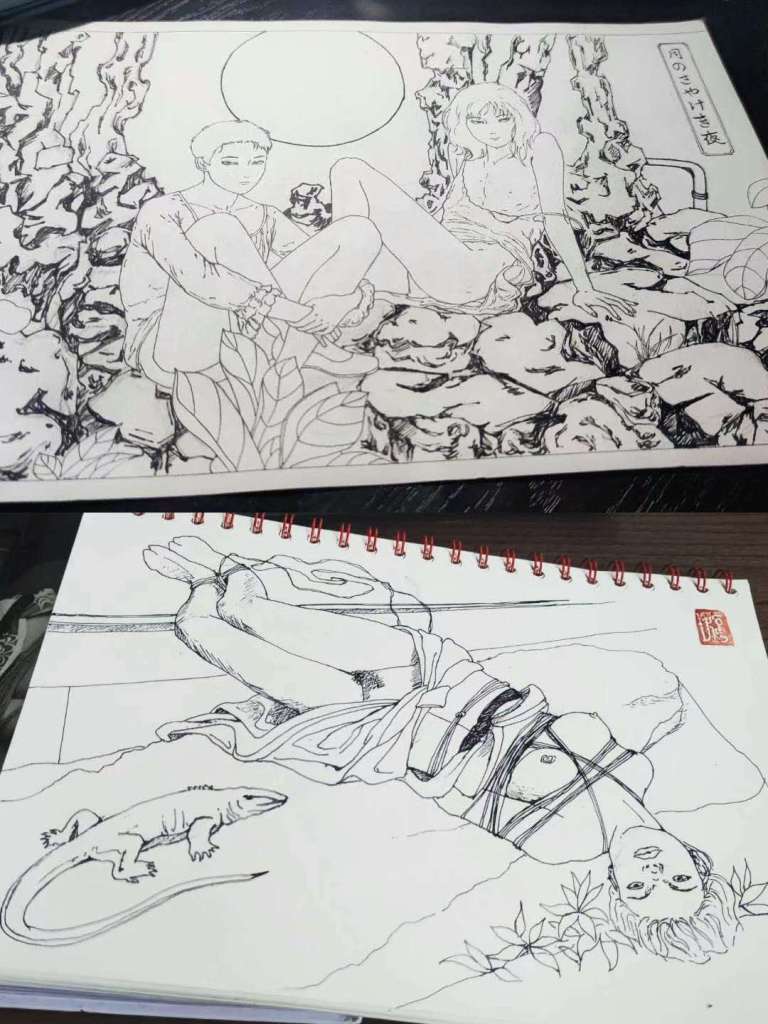


 REDUNDANCE OF MEMORIES